How Buyers Choose a SanDisk Industrial Micro SD Card for Embedded Systems
目錄
How Buyers Choose a SanDisk Industrial Micro SD Card for Embedded Systems
Quick Answer: Select a SanDisk industrial micro SD card according to operating temperature, daily write volume, endurance, host compatibility, and supply continuity. Before volume purchasing, verify the exact part number and test samples under realistic workloads, temperatures, and power-loss conditions.
Storage selection directly affects the uptime of edge devices, industrial controllers, surveillance systems, and automated monitoring equipment. A card that passes an initial test may still develop performance or data-integrity problems after prolonged writing, repeated shutdowns, or exposure to severe temperatures.
Technical buyers must answer three questions:
How does an industrial card differ from retail and high-endurance alternatives?
Which specifications match the real workload and environment?
How should engineering and procurement teams qualify the card before production?
This guide explains how to select and validate a SanDisk industrial micro SD card using measurable technical and sourcing requirements.
What Is a SanDisk Industrial Micro SD Card?
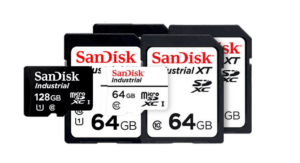
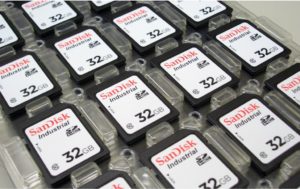
A SanDisk industrial micro SD card is removable flash storage designed for embedded and commercial equipment operating under demanding conditions. It is evaluated by its complete hardware, firmware, environmental, and lifecycle specifications—not just capacity or speed.
Core Industrial Features
Depending on the series and part number, important features may include:
Extended operating temperatures for outdoor, vehicle, and factory equipment
Rated write endurance for estimating operational life
Health status monitoring for preventive replacement
Automatic read refresh to support long-term data integrity
Host lock for compatible access-control applications
Industrial controller firmware for wear and bad-block management
Product traceability for maintaining an approved configuration
Feature availability varies by model. Always check the current product brief for the complete part number.
Common Applications
Application
Main Storage Requirement
Industrial PCs and PLCs
Reliable booting and repeated log writes
IoT and edge gateways
Continuous telemetry and remote operation
Surveillance systems
Sustained video recording
Fleet and navigation devices
Temperature and power-cycle stability
Factory automation
Long service life and predictable maintenance
Outdoor monitoring
Environmental resilience
The term “industrial” does not guarantee one universal NAND type, endurance rating, or temperature range. The SD Association states that enhanced temperature operation, endurance, and environmental resistance are manufacturer-specific features—not universal requirements of the SD standard.
Before approving a card, verify:
Manufacturer part number
Operating temperature
Published endurance
Host and capacity compatibility
Supported firmware functions
Lifecycle and sourcing requirements
Industrial vs. Retail and High-Endurance microSD Cards
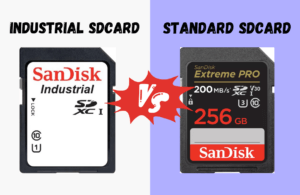
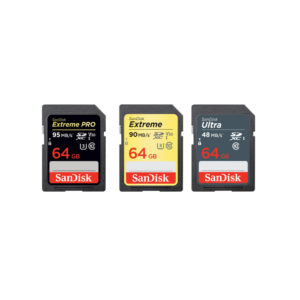
Retail, high-endurance, and industrial cards serve different purposes. Retail products balance capacity, speed, and cost for personal electronics. High-endurance cards focus primarily on repeated video recording. Industrial cards are intended for embedded and commercial systems that require environmental qualification, workload endurance, monitoring, or controlled sourcing.
Selection Factor
Retail
High Endurance
Industrial
Primary use
Personal electronics
Repeated video recording
Embedded and commercial equipment
Continuous writes
Product-dependent
Designed for recording
Evaluated against a rated workload
Temperature
Check datasheet
Check datasheet
Wide-temperature options available
Health monitoring
Usually unavailable
Product-dependent
Available on supported models
BOM consistency
May change
Must be confirmed
Must be confirmed
Qualification
Basic compatibility
Recording tests
Host, workload, power, and thermal tests
SanDisk advises that retail memory cards for cameras, gaming, and personal applications should not be used for commercial or industrial workloads involving repeated reads and writes to the same locations.
High-endurance cards can suit supported video applications, but they do not automatically include every industrial capability. Health reporting, temperature ratings, firmware functions, and change-control arrangements depend on the exact model and purchasing program.
Why Speed Class Is Not Enough
Speed and endurance measure different characteristics:
UHS-I: Bus interface
Class 10, U1, or U3: Minimum write-performance classes
Video Speed Class: Sustained video-recording performance
TBW: Total supported write workload
Operating temperature: Rated environmental range
A high speed rating does not independently confirm industrial endurance. The host must support the required interface, and the card must sustain the application’s real write pattern.
Which Specifications Matter Most?
The correct SanDisk industrial micro SD card should be selected from the workload and environment—not capacity alone.
Operating Temperature
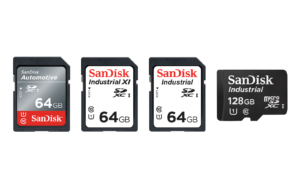
One published SanDisk industrial portfolio lists the following ranges:
Product Grade
Operating Range
Typical Environment
Industrial with -I suffix
-25°C to 85°C
Controlled industrial and commercial equipment
Industrial XI with -XI suffix
-40°C to 85°C
Outdoor, transportation, and severe cold conditions
Verify these suffixes and ranges against the current datasheet for the exact series. They are not universal rules for every product generation.
Also distinguish between:
Operating temperature: Range in which the card can function
Storage temperature: Non-operating storage limits
Device temperature: Actual temperature inside the enclosure
Internal heat from processors, power converters, or sealed housings can make the card hotter than the surrounding environment.
NAND and Endurance
NAND type affects density, performance, endurance, and cost. However, buyers should use the endurance value published for the specific product rather than relying only on an SLC or MLC label.
Verify:
Published endurance rating
Applicable capacity
Test conditions and workload
Health-reporting support
Required engineering margin
TBW is useful because it connects the product specification to the amount of data written over the expected service life.
Host Compatibility
Confirm that the host supports:
microSDHC or microSDXC
Selected capacity
Required UHS bus mode
Application file system
Booting from removable storage, if needed
Vendor-specific health commands, if used
Qualification must use the actual processor, operating system, driver, card socket, and production firmware.
How to Calculate Endurance and Capacity
Start by measuring everything the host writes each day:
Operating-system and diagnostic logs
Telemetry records
Image or video files
Database updates
Temporary files
File-system metadata
Firmware packages
Retry and write-amplification activity
Use this planning formula:
Required lifetime writes = Daily writes × 365 × Service years
For example, a gateway writing 20 GB per day for five years produces:
20 GB × 365 × 5 = 36,500 GB, or 36.5 TB
Add margin for workload peaks, software changes, write amplification, and differences between laboratory and field conditions. Compare the final estimate with the rating for the exact model and capacity.
Capacity planning should also include free space. Filling a card close to capacity can complicate log rotation and affect performance consistency. A larger card may provide additional working space, but its endurance must still be verified.
How to Qualify the Card Before Production
A desktop speed test does not establish industrial suitability. Sample qualification should reproduce the finished device’s operating conditions.
1. Record the Exact Configuration
Document:
Full part number
Product family and capacity
Temperature suffix
Datasheet revision
Endurance specification
Firmware identification, when available
Supplier and lot information
2. Test Host Compatibility
Verify:
Cold and warm boot detection
Power-up timing
Bus-mode negotiation
Sustained write performance
File-system mounting
Maximum supported capacity
Removal and recovery behavior
3. Reproduce the Real Workload
Test actual write sizes, frequency, queue patterns, log rotation, file deletion, and concurrent reads. Sequential benchmark files may not represent database, telemetry, or operating-system activity.
4. Test Power Interruptions
Interrupt power during:
File creation
Metadata updates
Sustained writes
System boot
File-system mounting
After each cycle, confirm that the card initializes, the partition mounts, and the application recovers correctly.
5. Validate Environmental Performance
Test the complete device at its required temperature and voltage limits. Where relevant, include vibration, repeated insertion, enclosure heat, and unstable power input.
6. Integrate Health Monitoring
If the card supports vendor-specific health reporting, confirm that the host can retrieve the data, record it, trigger a maintenance alert, and support planned replacement.
Power-Failure Protection: What the Card Cannot Guarantee
Industrial controller firmware can help protect internal NAND management and mapping information. It cannot guarantee that every host-level file operation will survive an unexpected shutdown.
Layer
Protection
Limitation
Card controller
NAND and internal mapping data
Cannot guarantee completion of uncommitted host data
File system
Metadata consistency and recovery
Cannot always protect application transactions
Host system
Shutdown and recovery controls
Depends on correct design and testing
A card may remain readable while the newest application file is corrupted. Depending on the system, engineers should consider:
Journaling file systems
Read-only system partitions
Atomic application writes
Write synchronization
Controlled log rotation
Hardware hold-up power
Shutdown detection
Integrity checks after reboot
Removable microSD cards do not contain the large discrete backup capacitors used in some enterprise storage devices. Zero-data-loss requirements must therefore be addressed at the host and application levels.
How Procurement Teams Can Reduce Supply Risk
Engineering approval is incomplete if procurement cannot repeatedly obtain the qualified configuration.
Before placing a volume order, confirm:
Exact part-number availability
Lot traceability
BOM and firmware consistency
Product Change Notifications
End-of-life notifications
Approved substitution procedures
Sample-to-production consistency
MOQ, lead time, and warranty terms
These controls depend on the product and supply agreement. They should be confirmed rather than assumed.
Keep approved golden samples and qualification records so incoming lots can be compared with the validated configuration. Do not substitute a similar capacity, speed class, or retail product without engineering review.
Uncontrolled marketplace sourcing may introduce mixed lots, uncertain origin, or products intended for different workloads. A qualified B2B supply route is especially important for devices with multi-year production lifecycles.
Selection Checklist
Before approving a SanDisk industrial micro SD card, confirm:
Exact product family and part number
Required operating temperature
Daily write volume and service life
Published endurance and test conditions
Capacity and host compatibility
Sustained write requirements
File-system recovery strategy
Power-interruption test results
Health-monitoring support
Environmental validation
Traceability and golden samples
Change-notification requirements
Availability, lead time, and MOQ
How Dellwa Supports Industrial microSD Procurement
Dellwa supports B2B buyers with product selection, sample coordination, availability checks, and bulk procurement for embedded and industrial applications.
For a more relevant recommendation or quotation, provide:
What is the difference between an industrial and retail microSD card?
An industrial microSD card is designed for embedded or commercial workloads that may require higher endurance, wider temperature support, health monitoring, and controlled qualification. Retail cards are generally optimized for personal electronics. Specifications still vary by model.
How do I select the correct card?
Start with operating temperature, daily writes, service life, capacity, sustained performance, and host compatibility. Calculate lifetime writes and test the exact part number in the finished hardware before production approval.
How do I estimate the required TBW?
Multiply daily writes by 365 and the expected service years. Add margin for workload peaks, write amplification, and future software changes. Compare the result with the published endurance of the exact product.
Can an industrial card prevent corruption during a power failure?
Industrial firmware can protect internal flash-management data, but it cannot guarantee host file-system or application integrity. Use journaling, atomic writes, controlled shutdowns, and hardware power protection where required.
Can an embedded device monitor card health?
Supported industrial models may provide vendor-specific health information. Compatible host software is required to retrieve and interpret it. Verify command availability for the exact model.
What information is needed for a bulk quotation?
Provide the application, capacity, temperature range, daily writes, host platform, target part number, sample quantity, projected order volume, and delivery schedule.
Conclusion
A SanDisk industrial micro SD card should be selected from measurable workload, environmental, and lifecycle requirements—not capacity or speed class alone. Engineering teams should calculate lifetime writes, verify the exact part number, test realistic workloads, and evaluate power-loss behavior. Procurement teams should then confirm traceability, availability, change control, and production continuity.
Contact Dellwa to request samples, confirm current part availability, or obtain a bulk quotation for your embedded or industrial storage project.