

How Buyers Choose an Industrial Micro SD Card: A Procurement Guide
For procurement managers and engineers tasked with sourcing storage components, the decision-making process for selecting hardware goes beyond simple capacity or cost. When the application involves edge computing, vehicle telematics, or medical instrumentation, the choice of an industrial micro sd card determines the reliability of the entire system.
The Question: How Do Buyers Choose an Industrial Micro SD Card?
The central inquiry from procurement professionals regarding industrial micro sd card selection is: “What are the specific technical and supply chain criteria that differentiate an industrial-grade card from a consumer-grade alternative to ensure long-term system stability and project longevity?”
This question arises because the visible specifications—such as storage capacity—often appear identical across consumer and industrial tiers, leading to significant risks when components fail in field deployments. Procurement buyers must reconcile the initial unit cost with the long-term total cost of ownership.
The Answer: Performance, Endurance, and Reliability Metrics
Continuous logging and high-cycle write applications place greater stress on flash memory than occasional consumer file storage. If the selected card does not provide enough endurance for the real workload, the system may experience premature wear, recording interruptions, or data errors.
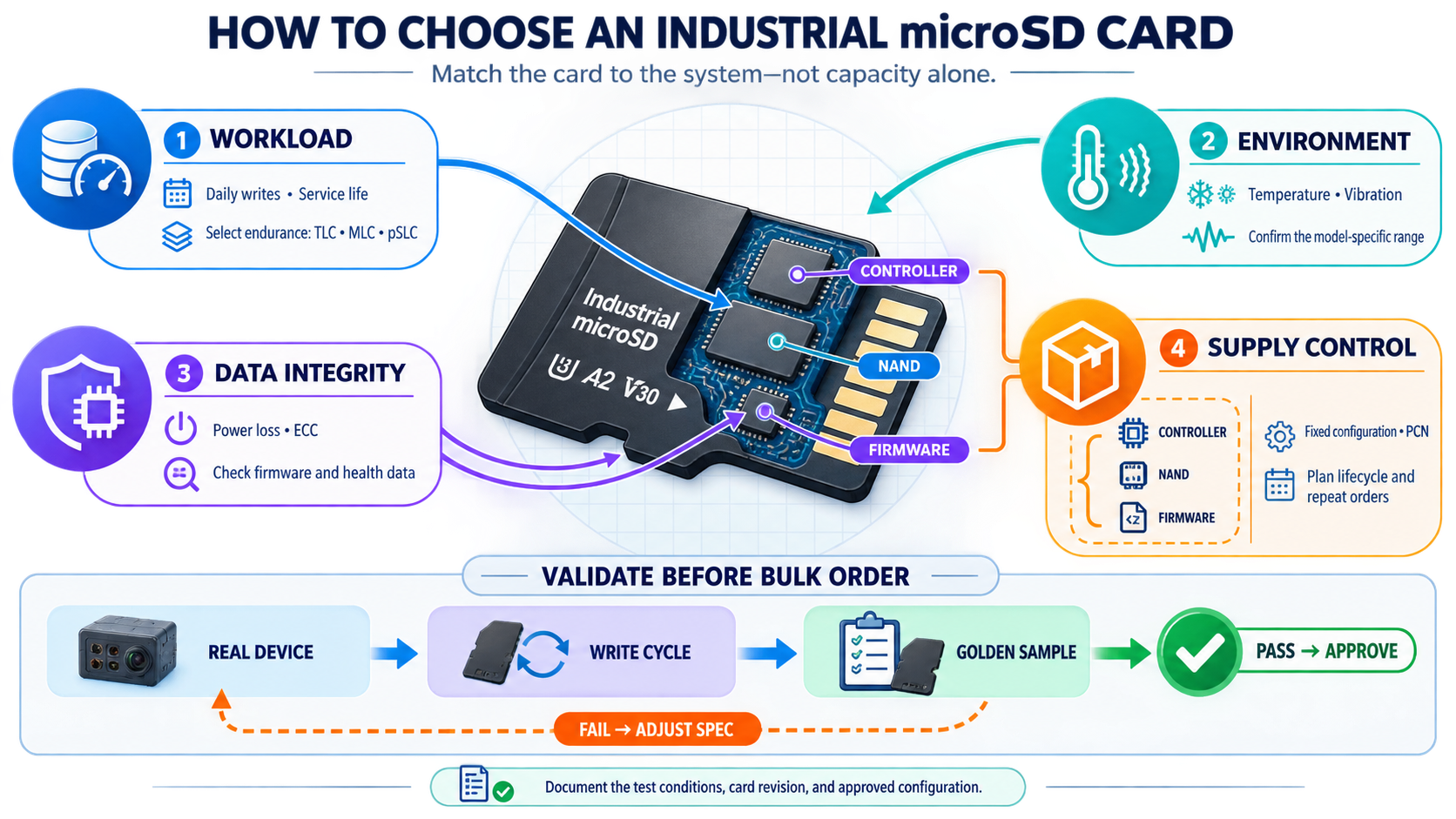
Industrial microSD cards may use controller-level functions such as wear leveling, bad block management, error correction, and health monitoring to improve reliability. The availability and implementation of these functions vary by model, so buyers should request product-specific documentation and validate the card in the actual device.
Supporting Evidence: Why Industrial Specifications Matter
Field failure data consistently highlights that consumer-grade SD cards, when subjected to 24/7 logging or high-cycle write environments, reach their endurance limits within weeks. In contrast, industrial micro sd cards are manufactured using controller-level management that includes aggressive wear leveling, bad block management, and ECC (Error Correction Code) routines that sustain integrity over thousands of cycles.
Research into procurement patterns indicates that failure to secure a fixed BOM often results in sudden changes to the controller firmware or NAND flash by the factory. Such changes necessitate expensive, unplanned re-testing cycles. Industrial suppliers mitigate this by providing a product change notification (PCN) process, which gives procurement teams the necessary lead time to manage inventory transitions without disrupting production lines.
Furthermore, the physical construction of an industrial micro sd card involves high-quality components soldered to a reinforced substrate, preventing disconnects caused by thermal expansion or vibration. When sourcing for OEM or ODM projects, these technical safeguards provide the stability required for sensitive industrial applications.
Technical Considerations for Bulk Procurement
When preparing for a bulk order or initiating a private-label agreement, buyers must scrutinize the supply chain as much as the component itself. Industrial storage supply is distinct because it requires a partnership model rather than a transaction-based approach.
Start with the Device Workload
Before selecting the NAND type or capacity, buyers should estimate how much data the device writes each day and how long the card is expected to remain in service. A capacity label alone cannot indicate whether a card has enough endurance for the application.
Workload Information to Collect
The workload description should include:
- Average recording bitrate
- Daily operating hours
- Percentage of time spent writing
- Loop-recording or overwrite behavior
- Average and maximum file size
- Required service life
- Acceptable maintenance interval
A vehicle camera recording continuously requires a different endurance profile from an IoT sensor that writes a small log every few minutes. The buyer should share the real workload with the supplier before deciding between industrial TLC, MLC, or pSLC.
Basic Endurance Estimate
A simple planning estimate can begin with:
Daily writes × 365 days × required service years
The result should then include a safety margin for workload peaks, file-system overhead, write amplification, and unexpected operating conditions. The supplier should explain how the proposed card’s endurance rating relates to this estimated workload.
NAND Flash Selection
Not all flash is created equal. While TLC (Triple-Level Cell) may be sufficient for light usage, industrial applications requiring extreme endurance often demand pSLC (Pseudo Single-Level Cell) mapping. This configuration sacrifices some raw capacity to gain significantly higher write-cycle capabilities, ensuring the memory controller does not hit a block exhaustion wall prematurely.
Operating Temperature Stability
Consumer cards typically function between 0C and 70C. An industrial micro sd card, however, must maintain data retention and read/write performance at extreme temperatures. When evaluating potential vendors, buyers should request formal qualification data verifying that the components maintain stability at both -40C and +85C, as these are the standard requirements for outdoor industrial equipment and automotive telematics.
Fixed BOM and Lifecycle Management
One of the most critical aspects of procurement is the guarantee of a fixed bill of materials. An industrial supplier ensures that the controller, firmware version, and NAND type remain constant for the duration of the product’s life. This allows for long-term consistency in OEM deployments, where any slight variation could cause system-wide software incompatibilities.
How to Qualify an Industrial MicroSD Card
A supplier datasheet helps narrow the product options, but final approval should come from testing the card inside the real device. The host controller, firmware, file system, temperature, power behavior, and writing pattern can all affect reliability.
Compatibility and Functional Testing
The device should consistently detect, format, read, and write to the card. Testing should cover cold boot, warm restart, card reinsertion, automatic formatting, and operation as the card approaches full capacity.
Sustained Write Testing
The test should reproduce the expected bitrate, file size, overwrite cycle, and daily operating schedule. Continuous-recording projects should test repeated loop recording instead of relying on a short desktop benchmark.
Temperature and Power-Cycle Testing
When relevant, the card should be tested inside the final enclosure under the expected temperature and vibration conditions. Buyers should also test unexpected power interruption while data is being written.
After each interruption, the system should verify:
- Successful restart
- File-system integrity
- File accessibility
- Recording continuity
- Error or health-status information
Golden Sample Approval
The approved card and test record should become the golden sample for mass production and repeat orders.
| Approval item | Information to record |
|---|---|
| Card | Model, capacity and specification revision |
| Device | Host model, firmware and file system |
| Workload | Bitrate, write pattern and test duration |
| Environment | Temperature, vibration and power conditions |
| Results | Performance, errors and recovery behavior |
| Supply | Controller, NAND and firmware where available |
If a later production batch changes a critical component or firmware revision, this record helps the buyer determine whether requalification is required.
Supplier Evidence and Lifecycle Documentation
A reliable industrial microSD supplier should support technical qualification and long-term purchasing with model-specific information. General claims such as “industrial grade” or “high endurance” are not sufficient without supporting specifications.
Documents Buyers Should Request
Depending on the project, the buyer may request:
- Product datasheet
- Endurance specification
- Operating and storage temperature range
- Supported speed classes
- SMART or health-monitoring information
- Reliability or qualification report
- Controller and NAND configuration
- Firmware revision
- Product change notification policy
- End-of-life notification policy
- Compliance documentation
The availability of each document should be confirmed for the exact model and revision being quoted.
PCN and End-of-Life Process
A product change notification should explain what is changing, why it is changing, which models are affected, and when the change will enter production. It should also provide enough time for the buyer to test the revised product.
An end-of-life notice should identify the last order date, final shipment schedule, and recommended replacement. For long-life OEM projects, replacement samples should be evaluated before the current model becomes unavailable.
Forecast and Repeat-Order Planning
Buyers should share annual demand, order frequency, forecast changes, and required delivery dates. The supplier can then discuss available inventory, production planning, MOQ, and expected lead time for the selected configuration.
Repeat orders should reference the previous purchase order, approved card revision, packaging, label, and golden sample rather than capacity alone.
FAQ
What does ‘Fixed BOM’ mean in the context of industrial storage?
Fixed BOM means the supplier guarantees that the core components of the industrial micro sd card—including the controller and the NAND flash—will not change during the production run without prior notification. This prevents the need for constant re-qualification of the device by your engineering team.
Why should I worry about MLC vs. pSLC for my project?
MLC is generally sufficient for applications with lower write intensity. However, pSLC offers significantly higher endurance by treating multi-bit cells as single-bit, allowing for more intensive write cycles before the NAND reaches its end-of-life. Choose based on your expected TBW (Total Bytes Written) requirements.
What is a typical lead time for industrial micro sd card orders?
Unlike consumer electronics that can be sourced from immediate stock, industrial micro sd card lead times are dictated by production cycles. Depending on the volume and customization required for private-label branding, lead times often range from four to twelve weeks. Early communication with your supplier regarding MOQ and rolling forecasts helps stabilize delivery schedules.
Does an industrial micro sd card require special formatting?
While they support standard filesystems like FAT32 or exFAT, industrial cards are often optimized for specific workloads. Discuss your application’s write patterns with the supplier, as custom firmware configurations can be implemented to optimize the card for specific file system overheads, reducing wear and improving speed.
How do I verify the reliability of a new supplier?
Verify reliability through technical documentation, sample testing, and supplier transparency. A reputable B2B industrial storage supplier will provide detailed datasheets, reliability reports, and a clear roadmap for future component support, ensuring your long-term project needs are met.