


An industrial compact flash card (industrial CF card) looks like a standard CompactFlash card, but it is built for harsh, long-running environments: automation, industrial control, POS terminals, medical equipment, military and security devices, and digital signage. Like every CF card it uses flash memory, so it needs no battery to keep its data and has no moving parts. This guide compares industrial grade and standard compact flash in ten points, then sets industrial CF cards against industrial SD cards and against SSDs, the two formats buyers most often weigh them against.
10 Key Differences: Industrial Grade vs Standard Compact Flash
1. Application Environment
Industrial grade: industrial applications, customized production, and long-term use in harsh working environments. Standard: commercial applications and mass production for general use.
2. Flash Memory Process
Industrial grade: uses flash from mature, proven process generations, for stable and reliable behavior. Standard: uses the latest process flash, where the production process is still being tuned to raise yield and reliability.
3. Capacity
Industrial grade: offered in smaller capacities, because it relies on mature flash and, often, SLC. Standard: follows the newest, densest flash to reach higher capacities.
4. Hardware Design
Industrial grade: designed to industrial standards, with enhanced design for electrical signals, EMI and mechanical structure, and tested against industrial standards. Standard: no special design beyond commercial regulations.
5. Firmware Design
Industrial grade: firmware emphasizes reliability, stability and durability. Standard: firmware emphasizes fast mass production within commercial standards.
6. Firmware Customization
Industrial grade: firmware and software can be tuned to the customer’s product and usage. Standard: no customer-specific firmware or software.
7. Fixed BOM
Industrial grade: supports a fixed bill of materials, with hardware and firmware version control. Standard: no fixed BOM; components change with price and stock, without notice to the customer.
8. Product Life Cycle
Industrial grade: a long, managed supply life, so a qualified design does not need requalification every year. Standard: short life cycles that follow consumer product generations.
9. Operating Temperature
Industrial grade: wide-temperature versions are available; confirm the exact range on the data sheet of the part you qualify. Standard: rated for normal room-temperature operation only.
10. Failure Analysis
Industrial grade: returned defective units are analyzed and the customer receives countermeasures. Standard: units are exchanged under warranty terms, with no failure analysis.
SLC and MLC in Industrial CF Cards
Industrial CF cards are built with SLC (single-level cell) or MLC (multi-level cell) flash; cheap TLC-based cards are not suitable for industrial use. SLC stores one bit per cell and endures far more program/erase cycles than MLC, which makes SLC compact flash the usual choice for write-heavy industrial applications. For the full comparison of cell types, see SLC vs MLC vs TLC vs QLC.
Industrial CF Card vs Industrial SD Card
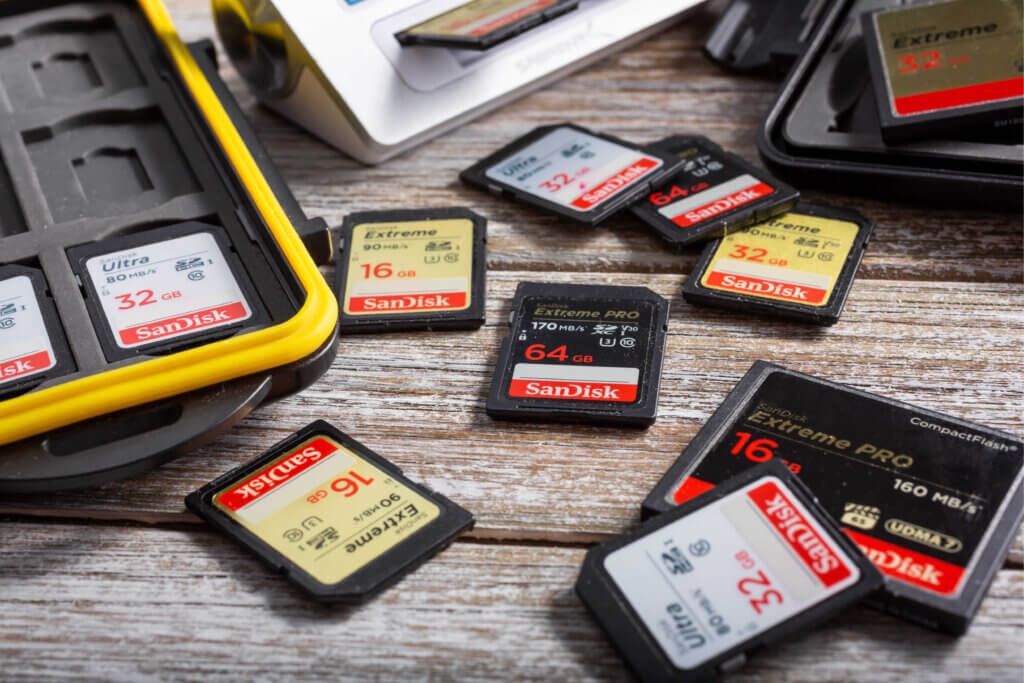
Both formats come from the same family of flash cards. SanDisk introduced CompactFlash in 1994. The SD card followed in 1999, developed jointly by Matsushita (Panasonic), Toshiba and SanDisk. The differences that matter to an equipment designer are the interface, compatibility, the flash inside, and the hosts each one fits.
| Industrial CF card | Industrial SD card | |
|---|---|---|
| Interface | Built-in controller with a standard ATA/IDE (PATA) interface, whatever the flash capacity; runs at 3.3V or 5V | SD bus; most cards today are SDHC or SDXC |
| Size | Larger; Type I and the thicker Type II | Smaller; full-size SD or microSD |
| Flash in industrial grades | MLC or SLC | MLC or SLC; mainstream consumer SD cards mostly use TLC |
| Typical hosts | POS machines, embedded systems, industrial PCs, legacy equipment with CF or IDE slots | Compact devices: camcorders and cameras, handheld devices, media players |
Speed depends on the interface mode the host supports and on the card itself, not on the format name, so compare the data sheets of the parts you shortlist. A CF card’s main strength is compatibility: its ATA interface lets it work in hosts designed for IDE storage. An SD card’s strength is its small size and its place in most new compact devices. For SD-based designs, see our industrial SD card guide.
Industrial Compact Flash Card vs SSD
An industrial compact flash card and an SSD (solid state drive) both store data on flash memory, and both are non-volatile, solid-state and more stable than a spinning disk drive.
- Form and interface: a CF card is a removable card in Type I or Type II thickness (the Type II slot was also used for micro hard disks). An SSD is a drive, usually on a SATA or M.2 interface.
- Architecture: an SSD spreads data across several flash chips that work in parallel, so larger SSDs are often faster. A CF card is a single compact card behind one controller.
- Fit: choose an industrial CF card when the host has a CF slot or an IDE interface and you need a removable, field-swappable medium. Choose an SSD for higher capacity and throughput in newer systems.
The SSD alternative to an industrial CF card is covered in our guide to industrial SSDs for automation. If you are comparing CF with its serial successor, see CF vs CFast memory cards.
Source Industrial CF Cards from Dellwa
Dellwa supplies industrial CF cards, industrial SD and microSD cards, and SSDs to equipment makers in automotive, telecom, GPS, embedded, recorder and display, medical, and server applications. See our memory card range, or contact Dellwa with your capacity, temperature and quantity requirements.