

Strategic Procurement Guide: How Buyers Choose Memory Cards for Kids
For B2B procurement professionals, the selection of storage components for children-oriented electronic devices involves more than just storage capacity. Whether you are sourcing components for educational tablets, digital cameras for kids, or interactive gaming consoles, the reliability of the memory card determines the end-user experience and product longevity. As an experienced OEM and ODM partner, we recognize that the requirements for this specific segment demand a rigorous approach to quality assurance and supply chain management.
Definition and B2B Relevance
Memory cards for kids refer to flash storage solutions (typically microSD or SD format) integrated into consumer electronics designed for younger users. These devices often operate in environments where physical durability, data integrity, and consistent write speeds are critical to preventing system failures.
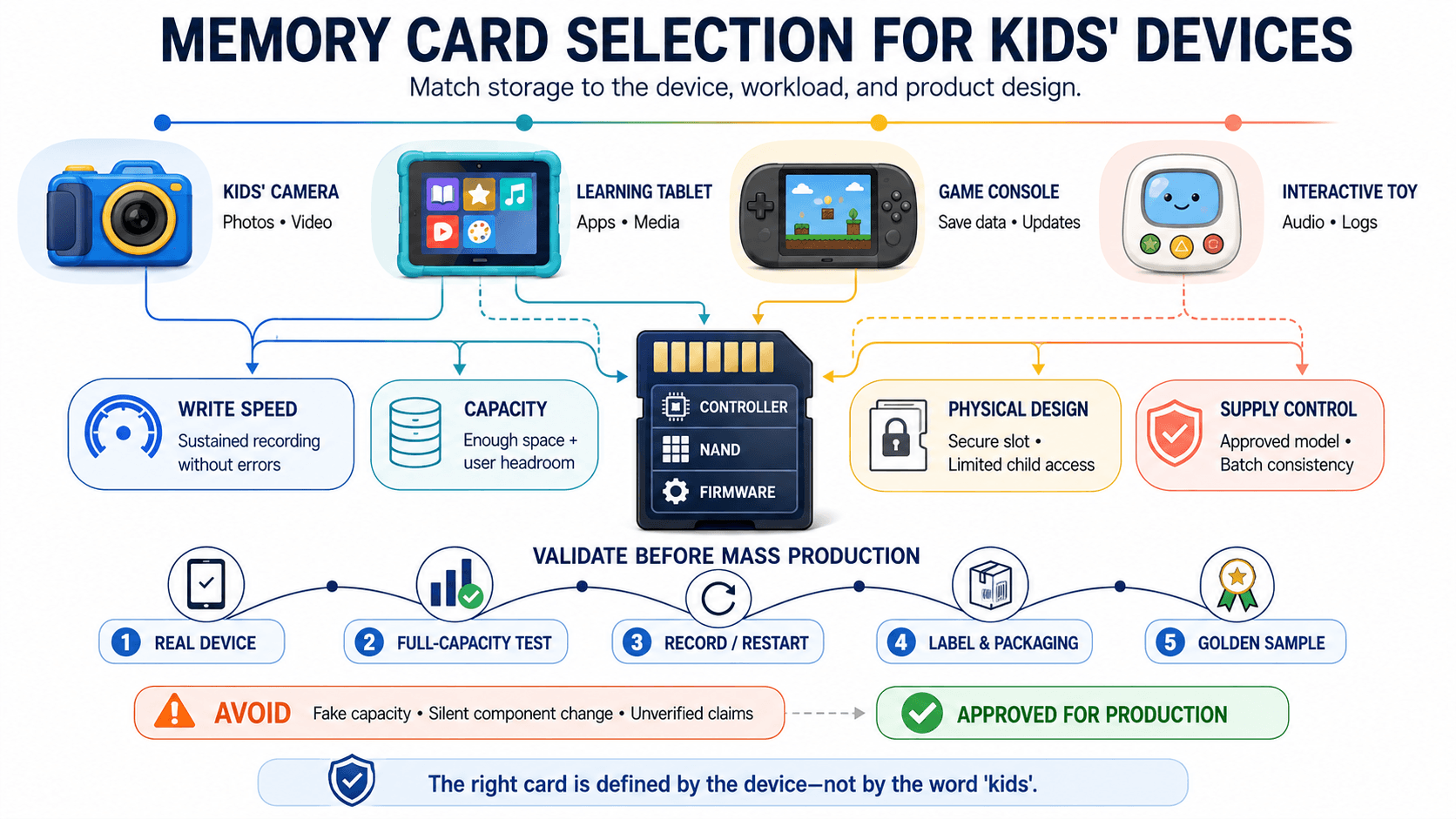
From a B2B procurement perspective, “memory cards for kids” is best understood as a device-specific sourcing requirement rather than a separate technical grade. The correct card depends on whether the device records video, runs applications, stores game data, or writes small log files.
Physical handling risk should be managed primarily through the device and card-slot design. When the card is installed inside a secured compartment, procurement teams should focus on compatibility, write performance, capacity, data integrity, component consistency, and product lifecycle.
When to Use It: Procurement Scenarios
B2B buyers typically integrate these storage solutions during the development and mass production phases of children’s hardware. Common scenarios include:
- Initial Product Development: Teams sourcing components for prototypes need high-quality samples that mirror the final batch performance. Relying on inconsistent storage components during testing leads to false negatives regarding software or hardware stability.
- Scaling for Mass Production: As production shifts to scale, maintaining a consistent bill of materials is essential. Buyers must partner with suppliers that can guarantee batch-to-batch uniformity, preventing sudden changes in flash controller specifications that could compromise device functionality.
- Private-Label Projects: Companies branding hardware for educational or toy retailers often require custom, private-label solutions. Selecting reliable memory components ensures that the brand reputation is not harmed by storage-related failures or data loss issues.
Match the Memory Card to the Device Type
The phrase “kids’ device” covers products with very different storage workloads. A camera writing video continuously should not use the same selection criteria as a toy that stores a small number of audio files.
| Device type | Typical storage activity | Main buying priority |
|---|---|---|
| Kids’ digital camera | Photos and continuous video | Sustained write speed and capacity |
| Learning tablet | Applications, media and user data | Capacity, random access and compatibility |
| Handheld game console | Save data, downloadable content and updates | Compatibility and reliable file access |
| Interactive toy | Audio, firmware and occasional logs | Stable supply and modest capacity |
| Educational recorder | Repeated audio or video recording | Endurance and sustained writing |
Do All Kids’ Devices Need Industrial-Grade Cards?
No. A standard card may be suitable for a low-cost device with a light write workload and controlled indoor use. Industrial or high-endurance models become more relevant when the device records continuously, operates in wider temperatures, is difficult to service, or requires a longer production lifecycle.
Select by Risk, Not by Label
Buyers should consider the cost of a field failure. If a failed card causes lost user content, a product return, a service visit, or damage to the device brand, additional qualification and supply control may be justified.
Our portfolio, which includes memory cards and solid-state drives, is built to assist procurement teams in securing the right grade of component for their specific project needs.
Step-by-Step Approach for Procurement Operators
Operators managing large-scale procurement must follow a systematic workflow to minimize risk:
- Requirements Analysis: Define the target device’s data needs. High-resolution video or photo applications in kids’ cameras require higher write speeds (Class 10 or UHS-I/U3), whereas basic educational software might function on lower-cost, standard-speed cards.
- Supplier Qualification: Evaluate potential partners based on their ability to handle bulk orders and their technical support infrastructure. A dedicated OEM/ODM partner, such as Dellwa, provides technical documentation and product support that mass-market retailers cannot match.
- Compatibility and Stress Testing: Before finalizing an order, perform extensive testing on the specific memory cards within the intended hardware. Check for file system compatibility and durability under extreme temperatures or high-frequency usage.
- Negotiation and Lead Time Management: Address the supply chain early. Discuss MOQ (Minimum Order Quantity) requirements and lead times for bulk procurement to ensure that hardware assembly lines do not stall due to component shortages.
Capacity, Speed, and File-System Requirements
The required capacity and performance should be based on the content stored by the device and the amount of space the user needs after system files are installed.
Capacity Planning
Buyers should calculate the space required for:
- Operating-system or firmware files
- Preloaded applications
- Photos, video or audio
- Game saves and user profiles
- Future software updates
- User-accessible free capacity
A card that is nearly full at the time of shipment may create performance or update problems later. The specification should include sufficient free space for the expected product life.
Understanding Speed Requirements
Class 10, U1, U3, and Video Speed Class ratings describe particular minimum performance requirements. The correct rating depends on how the device writes data.
Camera and Video Applications
Video recording requires stable sustained write performance. A card with a high advertised peak speed may still create recording errors if it cannot maintain the required writing rate.
Learning and Gaming Applications
Devices running applications or accessing many small files may depend more on random read and write performance than on peak sequential speed.
File-System Compatibility
The card should be tested using the file system created or supported by the final device. FAT32 and exFAT support may vary according to capacity, operating system, and device firmware.
Formatting instructions should be confirmed before mass production, especially when cards are preformatted or loaded with content by the supplier.
Common Pitfalls to Avoid
Failure modes are common when procurement teams focus solely on the lowest unit price rather than total cost of ownership.
One significant pitfall is sourcing unbranded or counterfeit flash memory. These components often lack the controller quality of genuine products from industry leaders like SanDisk or Kingston. Counterfeit cards frequently report inaccurate storage capacities or fail after minimal use, leading to high return rates and customer dissatisfaction.
Another error is neglecting the firmware versioning. If a supplier changes the internal controller or NAND flash type mid-production without notifying the buyer, it can lead to compatibility issues with the device’s operating system. Effective procurement involves clear communication with suppliers to ensure that the hardware specification remains locked throughout the life of the product cycle.
Sample and Batch Validation Before Mass Production
A memory-card sample should be tested inside the final device using the intended firmware and software. A desktop speed test alone does not reproduce the complete user experience.
Recommended Device Tests
The validation plan should cover:
- Device detection and formatting
- Full-capacity verification
- Photo, video or application workload
- Repeated recording and deletion
- Restart during normal use
- Operation as the card approaches full capacity
- File accessibility after repeated cycles
- Firmware or software updates
Preloaded Content Verification
If the cards contain educational content, audio, applications, or configuration files, the buyer should approve the final folder structure and master-file version.
Verification may include file count, total data size, checksum comparison, sample opening, language review, and confirmation of the required free capacity.
Golden Sample and Batch Record
| Approval item | Information to retain |
|---|---|
| Card | Brand, model, capacity and speed rating |
| Device | Hardware model, firmware and operating system |
| Test | Workload, duration and measured results |
| Content | Master-file version and verification method |
| Supply | Controller, NAND and firmware where available |
| Packaging | Label, barcode and package format |
| Approval | Date, revision and responsible person |
The approved configuration should become the reference for mass production. If the supplier proposes a controller, NAND, firmware, or model change, the buyer can determine whether additional testing is required.
Real-World Application
Example Procurement Scenario
Consider a product team developing an interactive learning tablet for primary-school use. The device must store educational applications, video lessons, user progress, and periodic software updates.
Instead of selecting a card based only on capacity, the team first tests several models inside the production hardware. The qualification process covers application loading, repeated restart, file updates, near-full-capacity operation, and compatibility with the final operating-system build.
After selecting a suitable card, the procurement team records the approved model, capacity, controller configuration, firmware revision, label, and packaging. Future production orders reference this approved specification so that a component change does not enter the assembly line without review.
This process supports a stable transition from prototype testing to mass production while reducing the risk of storage-related compatibility problems.
For those looking to secure high-quality storage solutions, our contact page is the primary point of entry for inquiries regarding large-scale procurement and customized OEM/ODM arrangements.
FAQ
What is the advantage of using industrial-grade memory cards for kids’ devices?
Industrial-grade cards provide better durability, higher reliability, and longer lifecycle support compared to consumer-grade cards. This reduces the risk of data loss and hardware failure in products that see heavy daily use.
How does Dellwa support bulk orders and private-label requests?
We provide full-scale OEM and ODM services, allowing clients to procure memory cards in bulk with custom labeling, packaging, and technical verification. Our team manages the entire supply chain from sourcing to delivery.
Can you provide memory cards from major brands in bulk?
Yes, we facilitate bulk buying for industry-recognized brands such as SanDisk and Kingston. Contact us to discuss your specific requirements and current inventory availability.
How do I handle large-scale procurement and lead times?
To ensure your project remains on schedule, we recommend reaching out to our team during the early design phase. We can provide detailed information on lead times, MOQ, and shipping logistics tailored to your production schedule.