

An industrial SD card, also called an industrial grade SD card or industrial memory card, is a Secure Digital card that is designed, produced, and tested for harsh working conditions: extreme temperatures, shock and vibration, continuous writing, and long product lifecycles. Industrial SD cards follow the SD Association specification, so they fit the same slots as standard SD cards, but they differ in NAND flash, controller firmware, temperature rating, and supply control.
This guide starts with how SanDisk Industrial SD cards compare with standard SD cards, then covers NAND types, controller features, endurance, automotive-grade cards, and a step-by-step selection workflow for OEM and embedded buyers.
SanDisk Industrial SD Card vs Standard SD Card
On the surface, an industrial SD card and a standard SD card look the same: identical mechanical design, capacities, and form factors. The differences are inside, and they affect reliability, endurance, and total cost of ownership.
Definition and Primary Use Cases
SanDisk Industrial SD cards are designed for harsh environments where durability, reliability, and longevity are critical. They are used in manufacturing, transportation, military, and healthcare applications and are built to withstand extreme temperatures, vibration, and physical shock in mission-critical operations.
Standard SD cards are used in consumer electronics such as digital cameras, smartphones, laptops, and gaming consoles. They are designed for everyday use in stable environments and balance performance, capacity, and cost.
Comparison Table
| Feature | SanDisk Industrial SD Card | Standard SD Card |
|---|---|---|
| Operating Temperature | -25°C to 85°C (Industrial); -40°C to 85°C (Industrial XI) | Typically 0°C to 70°C |
| Capacity | Smaller maximum capacities (published portfolio: SD 8GB to 64GB, microSD 8GB to 128GB) | Wide range, up to 1TB |
| Speed | Class 10; similar peak speeds, maintained in harsh conditions | Similar peak speeds in stable conditions |
| Durability | High resistance to shock, vibration, and environmental stress | Standard resistance for everyday use |
| Data Protection | Advanced error correction, wear leveling, read refresh, power immunity | Basic error correction |
| Health Monitoring | Health status monitoring on supported models | Usually unavailable |
| Lifespan | Designed for continuous use | Moderate, suitable for regular use |
| Product Lifecycle | Extended lifecycle and availability | Models change frequently |
| Price | Higher | Lower |
Performance and Durability
Both card types offer similar read and write speeds. The difference is consistency: industrial cards keep performing across extreme temperatures, high humidity, and high-vibration settings, while standard cards are optimized for stable environments and may degrade or fail under severe temperature swings or physical stress. Industrial cards also use stronger error correction and wear leveling, so they last longer under heavy write loads.
Cost and Total Cost of Ownership
Industrial SD cards cost more up front because of their durability, reliability, and lifecycle features. In harsh or critical applications they are usually cheaper over time: fewer failures mean fewer replacements, less downtime, and less data loss. For everyday consumer devices, standard SD cards offer better value, but used in an unsuitable environment, frequent replacements can cancel the initial savings.
Where Each Card Fits
- Industrial applications: factory automation and data logging, fleet management and onboard diagnostics, ruggedized military devices, medical monitoring and diagnostic equipment, and energy equipment such as oil and gas exploration systems and wind turbines.
- Consumer applications: digital cameras, smartphones, laptops and tablets, gaming consoles, and portable media players.
SanDisk Industrial SD and microSD Series

SanDisk Industrial cards are built for industrial applications that need high reliability, durability, and high-intensity recording, such as surveillance cameras, transportation, industrial IoT gateways, factory automation, and network equipment. One published SanDisk industrial portfolio lists these series:
| Series | Operating Temperature | Capacities |
|---|---|---|
| SanDisk Industrial XI SD | -40°C to 85°C | 8GB to 64GB |
| SanDisk Industrial SD | -25°C to 85°C | 8GB to 64GB |
| SanDisk Industrial microSD | -25°C to 85°C | 8GB to 128GB |
| SanDisk Industrial XI microSD | -40°C to 85°C | 8GB to 128GB |
The series are Speed Class 10 U1, with sequential speeds of up to 80 MB/s read and 50 MB/s write. Verify ranges, capacities, and speeds against the current datasheet for the exact part number, because they can change between product generations.
Firmware and “smart” features include:
- Power immunity, read refresh, ECC, and wear leveling
- Health status monitoring, so operators can check card wear and plan replacement
- One-time programmable (OTP) ID
- Host lock
Extended product lifecycles reduce the total cost of ownership per system by avoiding costly redesigns and requalification and by cutting unnecessary maintenance calls. For model grades, endurance, and qualification steps for the microSD version, see how to choose a SanDisk industrial micro SD card.
SanDisk has also offered an Automotive SD series for connected cars and other automated machines, in 8GB to 64GB versions with read speeds of up to 80 MB/s. It did not include the Industrial series’ health-monitoring tool, but it carried AEC-Q100 Grade 3 qualification for automotive use, which covers -40°C to 85°C. Confirm current availability and specifications before you design it in.
Industrial vs Automotive SD Cards
Industrial-grade SD cards come as industrial-grade SD, industrial-grade microSD, and wide-temperature versions rated from -40°C to 85°C. They serve medical equipment, monitoring systems, and automated machines.
Automotive SD cards are held to a stricter standard. They are qualified to AEC-Q100, the automotive industry’s stress-test standard: Grade 3 covers -40°C to 85°C and Grade 2 covers -40°C to 105°C. They are designed for dash cams, ADAS, GPS navigation, infotainment, and event data recording, with better tolerance of power-supply interference, vibration, and the fast temperature changes inside a vehicle.
One practical point: in a device with a full-size SD slot, use a full-size SD card instead of a microSD card in an adapter. Vehicle vibration can make the adapter contacts unstable and interrupt recording.
NAND Flash: SLC, MLC, TLC, and pSLC
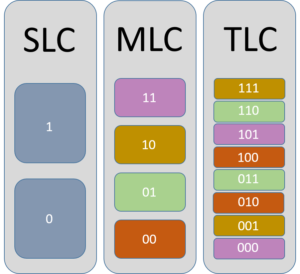
NAND flash is the key component of a memory card. The more bits each cell stores, the higher the density and the lower the cost, but the lower the endurance.
| NAND Type | Bits per Cell | Typical P/E Cycles | Cost | Typical Use |
|---|---|---|---|---|
| SLC (Single-Level Cell) | 1 | ~60,000 to 100,000 | Premium | Boot drives, high-frequency continuous logging |
| pSLC (Pseudo-SLC) | 1 (on MLC/TLC die) | ~20,000 to 30,000 | Mid-range | High-write embedded systems that need balanced cost and endurance |
| MLC (Multi-Level Cell) | 2 | ~3,000 | Moderate | General industrial logging with moderate writes |
| TLC (Triple-Level Cell) | 3 | ~1,000 to 3,000 | Lowest | Read-intensive applications with infrequent writes |
These are typical figures. Use the endurance value published for the specific product rather than relying only on the NAND label. Industrial and automotive applications usually choose SLC, MLC, or pSLC. Pseudo-SLC runs multi-level cells in single-bit mode through controller firmware, trading capacity for higher endurance and write speed at a lower cost than native SLC. 3D NAND stacks cells vertically, which increases capacity and reduces interference between cells.
Good NAND also needs a good controller: long-term stability depends on both. For SLC cards specifically, see how SLC SD cards increase efficiency.
Controller Features That Protect Data
- Error Correction Code (ECC): Detects and corrects bit errors. Modern industrial controllers may use LDPC decoding to recover bits distorted by heat or wear.
- Dynamic and static wear leveling: Spreads program/erase cycles across all physical blocks, so frequent log writes do not wear out a few blocks while static files sit on fresh ones.
- Read refresh: Frequent reads, especially at high temperature, can disturb neighboring cells. The controller scans and rewrites marginal blocks before errors become uncorrectable.
- Power-loss protection in firmware: A card has no room for large capacitors, so protection comes from firmware schemes such as an SLC-mode cache and multiple backups. Firmware can protect the card’s internal data, but it cannot guarantee that every host file write survives a sudden shutdown; design the host with a journaling file system, controlled shutdown, and integrity checks.
- Health monitoring: Supported cards report wear and remaining life. Device makers can read this through vendor-specific commands and build replacement alerts into their software.
How Long Do Industrial SD Cards Last?
An SD card’s life is set by the program/erase cycles of its NAND and by how much data the device writes. Lifetime writes can be estimated as daily writes × 365 × service years. A data logger writing 10 GB per day for five years needs about 18 TB of write endurance, plus a margin for workload peaks, write amplification, and software changes. Compare that figure with the published endurance (for example, TBW) of the exact model and capacity.
Several factors shorten card life:
- Heat: high temperatures increase charge leakage in flash cells and raise bit error rates.
- Small random writes: they increase write amplification, so the card writes more internally than the host sends.
- A nearly full card: little free space complicates log rotation and can affect performance consistency.
Wear leveling, overprovisioning, and SLC or pSLC NAND all extend service life, which is why industrial cards outlast standard cards under the same workload.
Speed Classes, Bus Interfaces, and Capacity Classes
| Rating | Meaning |
|---|---|
| Class 2 / 4 / 6 / 10 | Minimum write speed of 2 / 4 / 6 / 10 MB/s |
| UHS Speed Class U1 / U3 | Minimum sustained write speed of 10 / 30 MB/s |
| Video Speed Class V10 / V30 / V60 / V90 | Minimum sustained write speed of 10 / 30 / 60 / 90 MB/s |
| UHS-I bus | Up to 104 MB/s |
| UHS-II bus | Up to 312 MB/s |
| SD Express | PCIe-based interface with speed classes E150 to E600 |
A speed class does not confirm endurance, and the host must support the bus mode to reach the card’s speed. Newer interfaces such as UHS-II and SD Express need cross-device testing before they go into legacy equipment.
Capacity classes follow the SD Association definitions: SD up to 2GB, SDHC above 2GB up to 32GB, SDXC above 32GB up to 2TB, and SDUC above 2TB up to 128TB. Industrial buyers usually follow a “sufficient capacity” rule and choose the capacity the application needs, plus free space for log rotation, rather than the largest card available.
Industrial SD Card Applications
The industrial market covers factory automation and industrial computers, plus sectors with similar needs for stability, long life, and harsh-environment operation, such as rail transit, automotive, medical, military, and aerospace. Typical applications:
- Industrial automation, PLCs, and industrial PCs
- Embedded systems and industrial IoT gateways
- Transportation, fleet telematics, and GPS navigation
- Surveillance and monitoring systems
- Medical equipment
- Energy equipment
- Military and aerospace systems
- Dynamic digital signage and vending machines
- In-car systems: dash cams, ADAS, and navigation
How to Select an Industrial SD Card: Step by Step
One card cannot fit every application: the best industrial memory card is the one that matches your workload, environment, and host. Work through these steps before volume purchasing.
Step 1: Define the Application and Environment
Record what the card stores (operating system, logs, video, maps) and where the device runs. Measure the temperature inside the enclosure, not only the ambient air: a sealed, fanless chassis in the sun can run far hotter than its surroundings. Note shock, vibration, humidity, and how often the card is removed.
Step 2: Calculate the Daily Write Workload
Measure how much data the host writes each day and whether it writes in continuous streams or small bursts. Continuous sequential writing stresses blocks predictably; frequent random writes raise write amplification. The total over the target service life sets the minimum endurance.
Step 3: Confirm Host Interface and Compatibility
Check the form factor, capacity class, and bus mode the host supports. Then test the card in the actual host system: boot detection, file-system mounting, sustained write speed, and behavior near full capacity. Use the card’s health-monitoring tool before and after testing to see how much life the test consumed.
Step 4: Run Environmental and Power-Cut Qualification
- Sustained reads and writes at the lowest rated temperature
- Thermal shock cycling across the temperature extremes
- Continuous operation at the highest rated temperature
- Repeated power cuts during active writes, checking that the card and file system recover
Step 5: Audit Supplier Consistency and Change Management
Confirm that the supplier locks the bill of materials (BOM) and issues Product Change Notifications (PCN) before any change. Consumer cards can switch controllers or flash dies without a new part number; an industrial supply keeps the qualified configuration identical across multi-year production.
Questions to Ask an Industrial SD Card Manufacturer
- What grade of NAND flash is used? Consumer-grade flash is not suitable for industrial workloads.
- Which environmental specifications do the cards meet? Verify temperature, shock, vibration, and humidity ratings.
- Can you provide long-term supply commitments for this model?
- Which testing and QC procedures do you follow? Look for burn-in, temperature cycling, vibration, and power-cycling tests.
- Do you offer customization, such as firmware settings, overprovisioning for endurance, secure erase, or custom labeling?
- How do you ensure authenticity in your supply chain, for example with laser-engraved serial numbers and secure packaging?
Ask for technical specifications and reliability test reports, and buy only from reputable manufacturers and authorized distributors.
Best Practices for Maintaining Industrial SD Cards
- Monitor health: run diagnostics or health checks regularly and watch for falling read/write speeds.
- Handle and install correctly: use anti-static precautions, avoid physical shocks, seat cards securely, and store spares in protective cases.
- Back up data: schedule regular automated backups, even on reliable cards.
Frequently Asked Questions
What is the difference between an industrial SD card and a standard SD card?
The main differences are durability, temperature tolerance, error correction, NAND type, and lifespan. Industrial SD cards are built for extreme conditions and continuous writing; standard SD cards are designed for consumer use in stable environments.
Can standard SD cards be used in industrial applications?
They can technically work, but they are not recommended. Their lower durability and narrower temperature range make them more likely to fail in harsh conditions, which leads to data loss and higher maintenance costs.
Are industrial SD cards worth the extra cost?
Yes, when you need reliability in harsh conditions or when downtime, a field service visit, or data loss costs more than the price difference.
Does a faster speed class mean a more durable card?
No. Speed classes describe minimum write performance; endurance depends on the NAND, the controller, and the published endurance rating of the exact model.
How do I choose the right SD card for my application?
Start with the operating environment, daily write volume, service life, and host compatibility. For harsh industrial settings, choose an industrial SD card and test the exact part number in your device. For general consumer use, a standard SD card is sufficient and more cost-effective.
Source Industrial SD Cards for Your Project
Dellwa supplies industrial SD and microSD cards, including SanDisk Industrial, for OEM and embedded projects, with samples for qualification and bulk supply for long-term production. Browse our memory card range, read the industrial microSD card guide, or send us your application, capacity, temperature range, and expected volume.