What Is a High Endurance Micro SD Card? The Complete B2B Buyer’s Guide for Industrial Applications
Dash cams freeze mid-journey. Surveillance systems drop critical footage. Drone flight logs corrupt at altitude. In most cases, the cause isn’t faulty hardware — it’s a consumer-grade micro SD card pushed beyond its limits.
For B2B procurement teams, this guide covers what separates high endurance micro SD cards from standard ones, which industrial applications require them, and how to source them reliably at scale.
Quick Answer
A high endurance micro SD card is built for continuous, write-intensive use in harsh physical environments. Key differences from consumer cards:
- Uses MLC or pSLC NAND for dramatically higher write cycle tolerance
- Operates stably from -40°C to 85°C
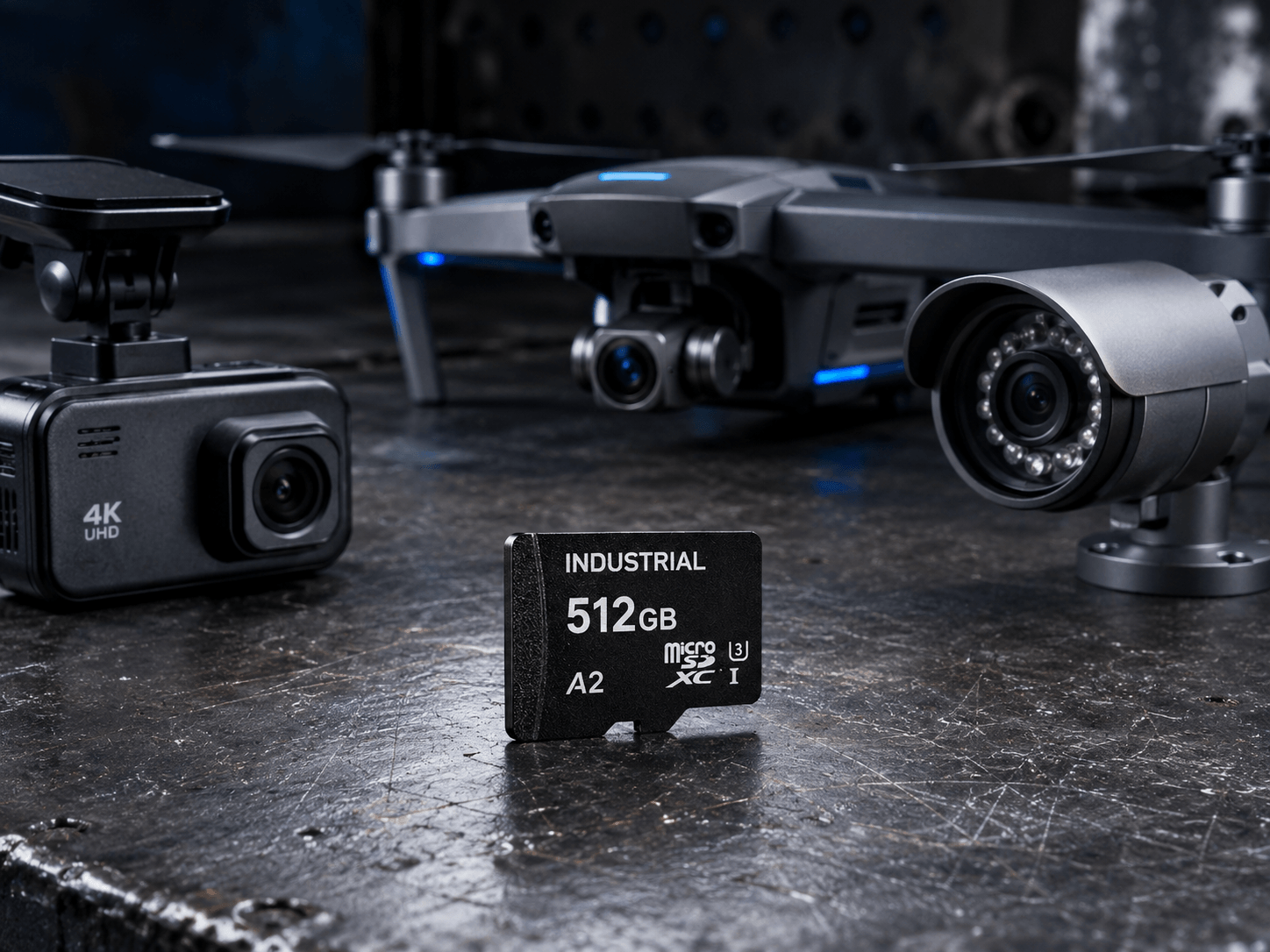
- Designed for 24/7 recording in dash cams, surveillance cameras, drones, and set-top boxes
1: What Makes a High Endurance Micro SD Card Different?
The critical metric most consumer cards never disclose: how many times the card can be written before it fails.
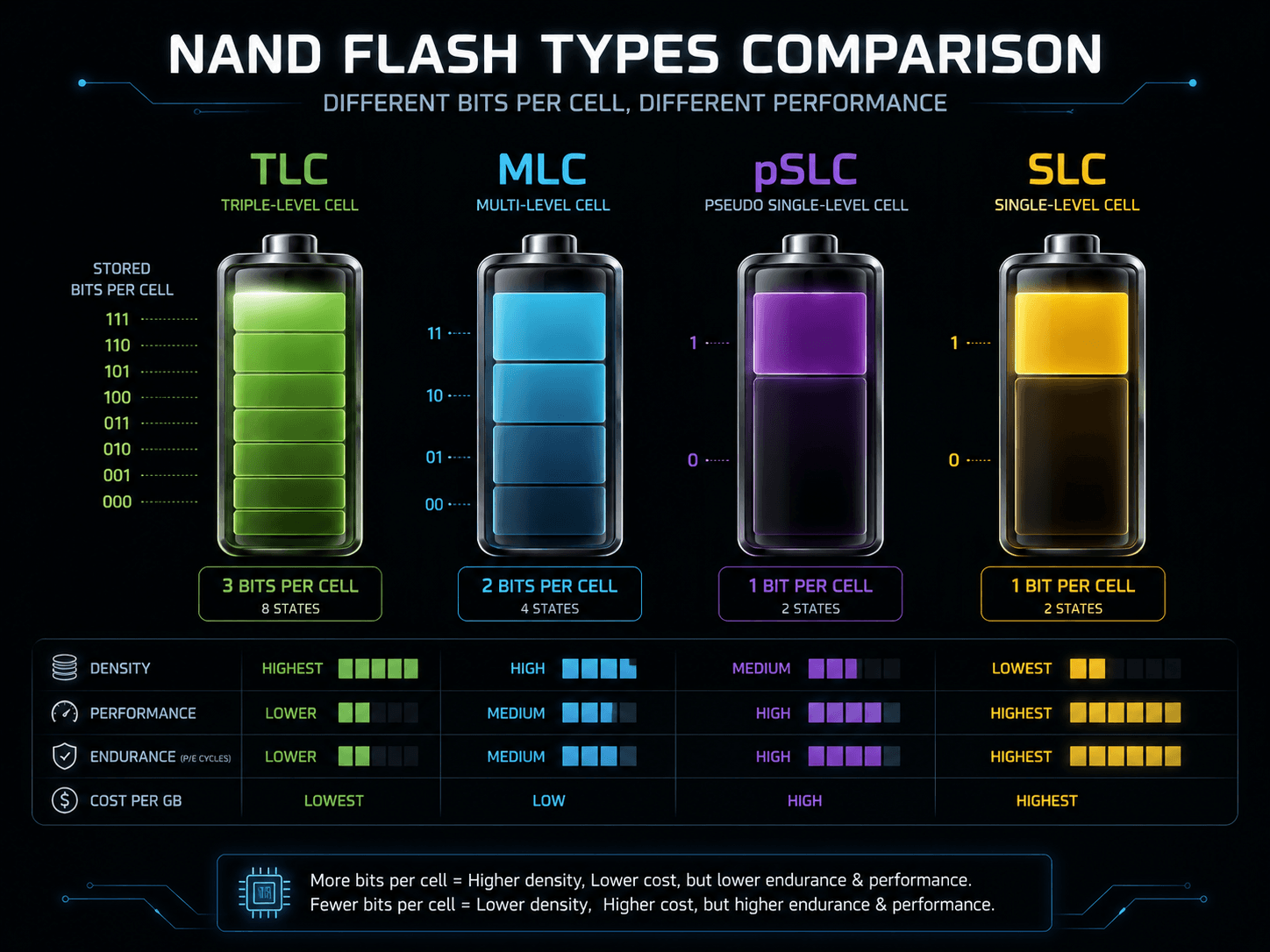
NAND Flash Type Comparison
| NAND Type | P/E Cycles | Cost | Best For |
|---|---|---|---|
| TLC | 500–1,000 | Lowest | Consumer / light use |
| MLC | 3,000–10,000 | Mid | Commercial workloads |
| pSLC | 30,000–100,000 | Mid-High | Industrial 24/7 recording |
| SLC | 100,000+ | Highest | Mission-critical environments |
For most B2B applications, pSLC is the sweet spot — it emulates SLC performance using MLC/TLC hardware, delivering industrial-grade endurance at a manageable procurement cost.
Key Specs to Evaluate When Sourcing
- P/E Cycles — writes per cell before degradation (pSLC: up to 100,000 vs TLC: ~500)
- TBW (Terabytes Written) — total lifetime write volume (e.g. Kingston 128GB industrial = 3,840 TBW)
- MTTF — Mean Time to Failure, for statistical reliability benchmarking across suppliers
2: Industrial Applications That Demand High Endurance Storage
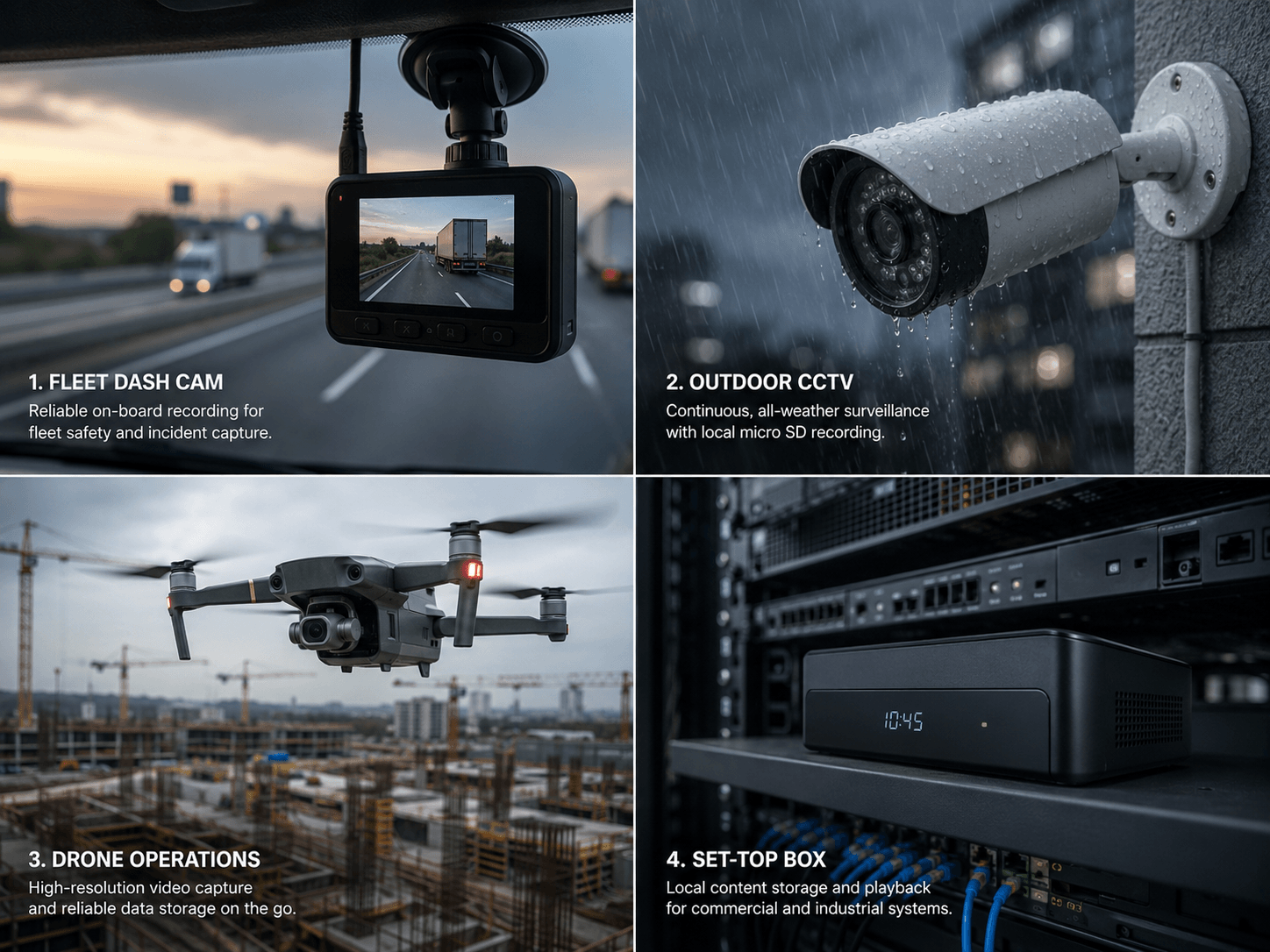
Not all write-intensive devices have the same requirements. Here’s how each major application differs:
Dash Cams & Fleet Management Systems
Challenge: Continuous loop recording, often in direct sunlight on vehicle dashboards.
- Cabin temperatures can exceed 70°C in summer
- Loop recording rewrites the same storage sectors constantly
- Fleet operators need zero data loss during incidents
Recommended spec: pSLC, min. 30,000 P/E cycles, operating temp -20°C to 70°C+
Surveillance & Security Cameras
Challenge: 24/7 recording with no scheduled downtime.
- Outdoor cameras face rain, humidity, and temperature swings
- Indoor server rooms may have vibration from HVAC systems
- Footage integrity is legally critical in many deployments
Recommended spec: MLC or pSLC, high TBW rating, waterproof-rated card
Drones & UAVs
Challenge: High-speed data capture at altitude under physical stress.
- Vibration and G-force during flight stress card connectors
- Cold temperatures at altitude can cause read/write slowdowns in consumer cards
- Requires fast write speeds (U3/V30 minimum) to handle 4K video
Recommended spec: pSLC, U3 A2 rated, -40°C to 85°C operating range
Set-Top Boxes & IoT Devices
Challenge: Silent, always-on embedded storage with no user maintenance.
- Devices may run for years without physical access
- Firmware logs and media caching create constant low-level writes
- Card failure = full device replacement cost
Recommended spec: MLC or pSLC, wide temperature range, long MTTF rating
3: Surviving Extreme Environments — Temperature, Shock & Humidity
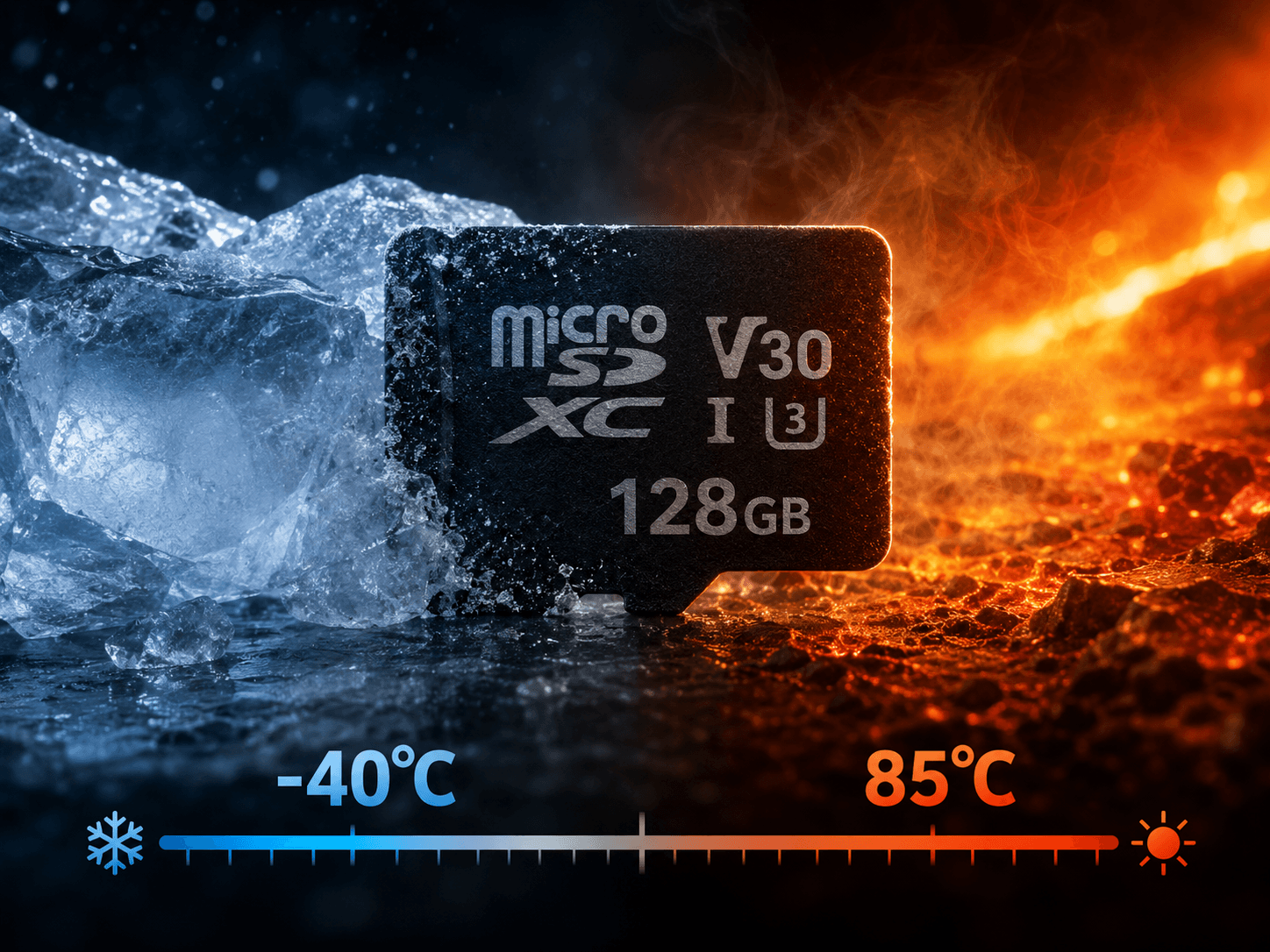
What -40°C to 85°C Really Means in Practice
| Environment | Typical Temp Range | Risk to Consumer Cards |
|---|---|---|
| Desert vehicle dashboard | Up to +80°C | Data corruption, solder fatigue |
| Cold chain / alpine deployment | Down to -30°C | Read errors, slow write speeds |
| Tropical outdoor camera | +40°C + high humidity | Oxidation, connector failure |
| Industrial freezer monitoring | -20°C to -40°C | Complete card failure |
Industrial-grade high endurance cards are validated across this full range — consumer cards typically only guarantee 0°C to 70°C.
Beyond Temperature — Full Environmental Protection
High endurance industrial micro SD cards are rated for:
- Waterproof — IPX7 or equivalent submersion protection
- Shockproof — withstands drops and mechanical impact
- Vibration-resistant — stable in vehicle and drone applications
- X-ray proof — safe through airport and logistics scanning
- Anti-magnetic — no data loss near magnetic fields
4: How to Choose the Right High Endurance Micro SD Card for Your Product
Procurement Checklist
| Specification | What to Look For |
|---|---|
| Capacity | Match to recording duration needs (e.g. 128GB for 24hr 1080p loop) |
| Speed Class | U3 / V30 minimum for video; A2 for app-intensive IoT |
| NAND Type | MLC for moderate workloads; pSLC for 24/7 write-intensive use |
| Temp Range | -40°C to 85°C for true industrial deployment |
| TBW Rating | Higher = longer card lifespan = lower replacement cost |
| Certifications | Look for CE, RoHS, FCC compliance for regulated markets |
Brand vs OEM — Which Makes More Sense for B2B?
| Branded (SanDisk / Kingston / Samsung) | OEM / Custom-Brand | |
|---|---|---|
| Pros | Instant end-user recognition, proven track record | Lower unit cost, custom logo/packaging, exclusive specs |
| Cons | Higher cost, limited customization, MOQ restrictions | Requires supplier vetting |
| Best for | Retail-facing products | OEM device manufacturers, private label brands |
If you’re embedding the card inside a finished product (e.g. a dashcam unit or security camera), OEM is almost always the more cost-effective path.
5: OEM & ODM Options — Custom High Endurance Micro SD Cards for Your Brand
Sourcing a custom-branded or application-specific card is more accessible than most procurement teams expect.
What Can Be Customized
- Logo & branding — card surface printing, custom color shell
- Capacity — specify exact GB/TB to match device requirements
- Packaging — retail blister pack, bulk tray, anti-static bag
- Firmware — speed tuning, pre-loading, lock zones
- NAND grade — specify MLC or pSLC per application
MOQ & Lead Times — What to Expect
| Order Type | Typical MOQ | Lead Time |
|---|---|---|
| Standard bulk (unbranded) | 100–500 pcs | 1–2 weeks |
| Custom logo / shell | 1,000–5,000 pcs | 3–4 weeks |
| Full ODM (custom firmware + packaging) | 5,000+ pcs | 6–10 weeks |
Working with a specialist supplier like eFox allows you to combine SanDisk, Kingston, or Samsung NAND with custom branding and industrial-grade specifications — bridging the gap between off-the-shelf and fully bespoke.
6: Why Source High Endurance Micro SD Cards from a Specialist B2B Supplier?
Buying industrial memory cards through retail channels or general distributors introduces risks that specialist B2B suppliers are specifically set up to eliminate.
Quality Consistency Across Large Batches
Key risks with non-specialist sourcing:
- Mixed NAND batches — same SKU may ship with different NAND grades across orders
- No incoming QC — counterfeit or downgraded cards in bulk shipments
- No traceability — unable to identify root cause if field failures occur
A specialist B2B supplier provides batch certificates, NAND origin disclosure, and consistent grade guarantees across repeat orders.
After-Sales Support & Compatibility Testing
What to expect from a qualified industrial memory supplier:
- Pre-shipment compatibility testing with your specific device model
- RMA process with clear failure analysis reporting
- Long-term supply agreements — critical when your product has a 5–10 year lifecycle
- Technical support for NAND migration when components are EOL (End of Life)
Conclusion
High endurance micro SD cards are not a premium upgrade — for industrial applications, they are a baseline requirement. Choosing the wrong card doesn’t just risk device failure; it risks data loss, warranty claims, and brand reputation.
Quick summary for B2B procurement teams:
- Use pSLC for 24/7 write-intensive applications (dashcams, surveillance, drones)
- Always verify P/E cycles, TBW, and operating temperature range — not just capacity and speed
- Consider OEM/custom-branded cards when embedding storage inside finished products
- Source from a specialist B2B supplier who can guarantee batch consistency and long-term supply
Ready to source high endurance micro SD cards for your next project? Contact eFox for bulk pricing, OEM consultation, and compatibility testing — whether you need 100 units or 100,000.
Whether you need SanDisk or Samsung high endurance micro SD cards in bulk, or want a custom solution under your own brand, eFox has you covered. We supply industrial-grade memory cards for dash cams, surveillance systems, drones, and IoT devices — with OEM/ODM services, flexible MOQ, and batch consistency you can rely on.
Explore our product range or Contact us for a quote
FAQ
Q: What is a high endurance micro SD card?
A: It’s a micro SD card built with MLC or pSLC NAND flash for continuous, write-intensive use in industrial devices — delivering up to 100,000 write cycles and stable operation from -40°C to 85°C.
Q: What’s the difference between a high endurance micro SD card and a regular one?
A: Regular cards use TLC NAND rated for 500–1,000 write cycles; high endurance cards use MLC or pSLC NAND rated for 30,000–100,000 cycles, with added protection against extreme temperatures, shock, and moisture.
Q: How long does a high endurance micro SD card last in a dash cam?
A: A pSLC industrial card recording 1080p continuously can last 3–5+ years, compared to 6–12 months for a consumer TLC card in the same device.
Q: Which micro SD card is best for surveillance cameras running 24/7?
A: Choose an MLC or pSLC card with a TBW rating above 1,000 and a wide operating temperature range rated for your deployment environment.
Q: Can I use a regular micro SD card in a drone?
A: Not recommended — drones combine vibration, altitude cold, and high-speed 4K writes that cause consumer TLC cards to slow down or fail mid-flight.
Q: What does pSLC mean and why does it matter for industrial buyers?
A: pSLC programs each NAND cell with one bit instead of two or three, delivering SLC-level endurance (30,000–100,000 P/E cycles) at a lower cost — the best balance of durability and procurement value.
Q: What should B2B buyers look for when sourcing micro SD cards in bulk?
A: Prioritise NAND grade disclosure, TBW/P/E cycle ratings, batch consistency guarantees, and OEM/ODM flexibility from your supplier.