

SSD TBW and DWPD: Calculating Endurance for Industrial Data Logging
An industrial data logger may overwrite the same files every day while keeping its storage usage relatively stable. That does not mean its SSD experiences little wear. A drive holding only a few hundred gigabytes can accumulate hundreds of terabytes of writes throughout a deployment.
For engineers and procurement teams, SSD endurance planning starts with three questions: How much data reaches the drive each day? How long must the system operate? What endurance rating applies to the exact SSD capacity being considered?
TBW and DWPD help connect those requirements to a product specification. This article explains the calculations using an illustrative industrial logging workload.
What Do SSD TBW and DWPD Mean?
TBW, or Terabytes Written, describes an SSD’s rated cumulative write endurance. A specification of 350 TBW represents a write budget of 350 terabytes under the manufacturer’s stated conditions.
DWPD, or Drive Writes Per Day, expresses that endurance relative to drive capacity and a specified period. A 1 TB drive rated at 0.3 DWPD over five years corresponds to approximately 300 GB of writes per day across that period. Always read DWPD together with its duration. solidigm.com
| Metric | What it describes | What to check |
|---|---|---|
| TBW | Cumulative rated write volume | Exact model, capacity and rating conditions |
| DWPD | Daily write volume relative to drive capacity | Capacity and the period used for the rating |
| Capacity | Space available to hold data | Retention needs, software and working space |
These values answer different planning questions. Capacity determines how much data can remain on the drive. Endurance determines the cumulative write workload it is rated to support.
Measure Daily Writes Before Selecting an SSD
Begin with a representative system running the intended application. Record the increase in the drive’s documented host-write counter over a known interval, using the manufacturer’s utility or supported monitoring tool.
Include normal production, startup, database maintenance, diagnostic logging and scheduled updates. Verify the counter’s units and interpretation for the exact model.
Use this calculation:
Average daily host writes = Increase in cumulative host writes ÷ Measurement days
For example, if the counter increases by 840 GB over seven days:
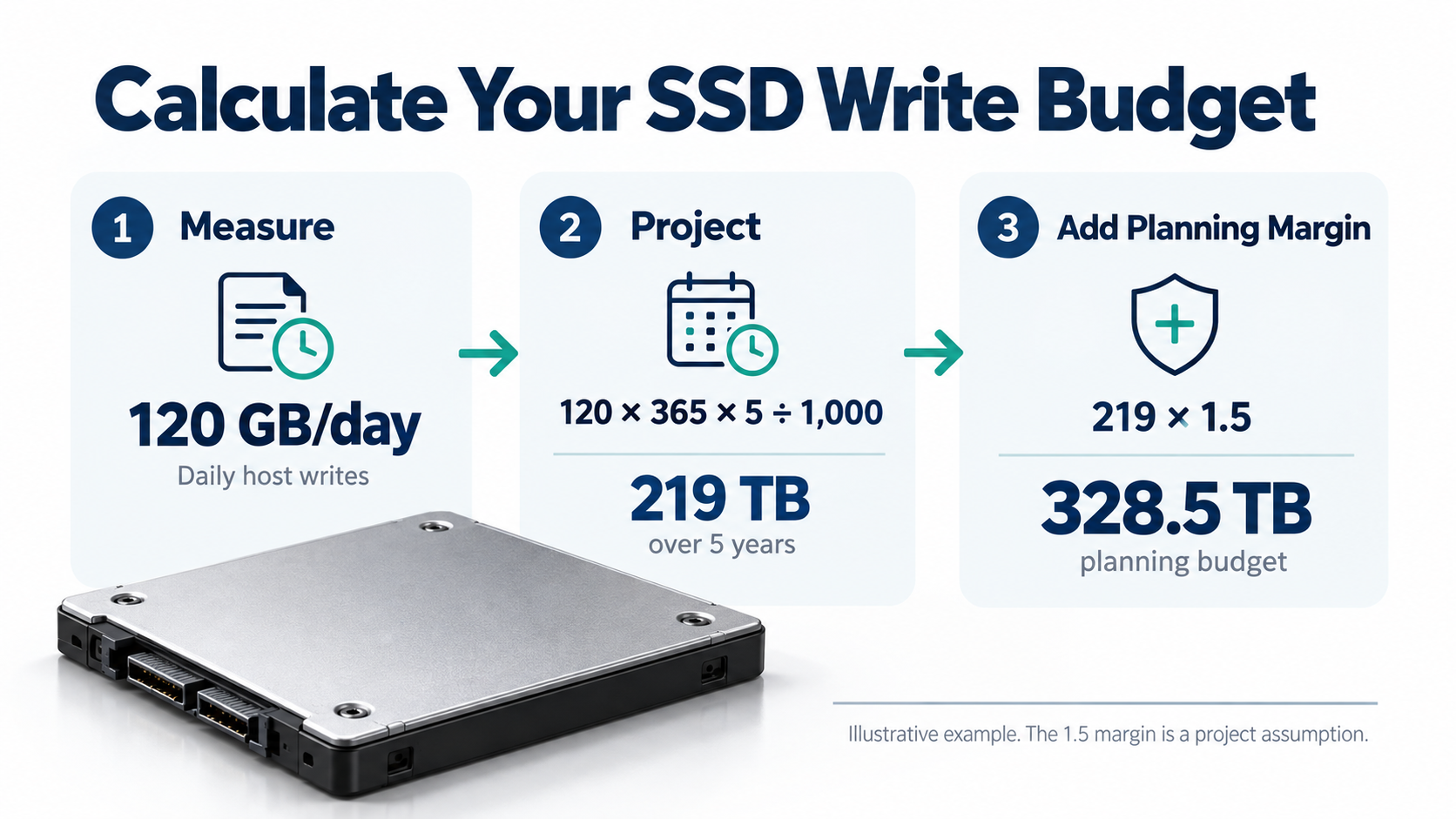
840 ÷ 7 = 120 GB/day
Treat 120 GB/day as the measured baseline for that observation period. If those seven days exclude a major production cycle or maintenance event, extend the measurement before making a purchasing decision.
The final size of saved log files is an incomplete estimate. Your measurement should capture writes reaching the SSD, including activity beyond the primary logging application.
Calculate the Write Budget for Your Deployment
For a first planning estimate:
Required write budget in TB = Daily writes in GB × Operating days ÷ 1,000
For a five-year system operating every day:
Operating days = 365 × 5 = 1,825
Using the illustrative workload above:
120 × 1,825 ÷ 1,000 = 219 TB
The application therefore projects 219 TB of host writes over five years, assuming the daily workload stays unchanged.
Allow for expected growth and uncertainty. For illustration, applying a 1.5 planning factor gives:
219 × 1.5 = 328.5 TB
That factor is an engineering assumption for this example, not a universal industry requirement. Select your margin from measured variability, planned software changes and the consequences of replacement.
| Planning input | Illustrative value |
|---|---|
| Measured daily host writes | 120 GB |
| Operating schedule | 365 days/year |
| Deployment period | 5 years |
| Projected cumulative writes | 219 TB |
| Illustrative planning factor | 1.5 |
| Planning write budget | 328.5 TB |
If the equipment operates only on production days, use the actual deployment schedule. When converting a manufacturer’s TBW into its equivalent DWPD, however, use the period associated with that rating.
Convert TBW to DWPD
Use consistent units:
DWPD = TBW × 1,000 ÷ (Capacity in GB × 365 × Rating period in years)
The reverse calculation is:
TBW = DWPD × Capacity in GB × 365 × Rating period in years ÷ 1,000
Kingston uses this relationship to express cumulative endurance as daily writes across the warranty period. Kingston Technology
Consider a hypothetical 512 GB SSD rated at 350 TBW over five years:
DWPD = 350 × 1,000 ÷ (512 × 365 × 5)
DWPD ≈ 0.375
Its equivalent daily write budget is:
350 × 1,000 ÷ 1,825 ≈ 192 GB/day
The illustrative application requires 180 GB/day after applying its planning factor:
120 × 1.5 = 180 GB/day
This candidate passes that initial arithmetic check. It still needs workload and system validation.
Why a Higher DWPD Is Not Always a Larger Write Budget
DWPD is normalized by capacity. Comparing the number alone can therefore hide an important difference.
The following candidates are hypothetical:
| Specification | Candidate A | Candidate B |
|---|---|---|
| Capacity | 512 GB | 1,024 GB |
| Rated endurance | 350 TBW | 600 TBW |
| Rating period | 5 years | 5 years |
| Calculated DWPD | Approximately 0.375 | Approximately 0.321 |
| Equivalent daily write budget | Approximately 192 GB | Approximately 329 GB |
Candidate A has the higher DWPD. Candidate B supports the greater absolute write volume across the same period.
For a logging application, compare both cumulative TBW and daily GB allowance. Then evaluate whether the capacity can hold the required records.
Check Data Retention Separately
Suppose the application retains 80 GB of new records per day for seven days:
80 × 7 = 560 GB
A 512 GB SSD cannot accommodate those retained records alone, even if its endurance calculation passes. The system also needs space for software, databases and temporary operations.
Overwriting or deleting older records controls occupied space. It does not reverse the writes already accumulated.
Specify retention capacity and endurance as separate requirements so that a technically suitable write rating does not lead to an undersized drive.
Match the Rating to the Actual Workload
Write amplification occurs when the SSD writes more data internally to NAND than the host sends. Controller behavior and over-provisioning influence this internal work; additional reserved space can improve endurance and sustained performance. Kingston Technology
Avoid multiplying measured host writes by an assumed write amplification factor and directly comparing that result with a host-write TBW rating. First confirm whether the specification and monitoring counter describe host writes or NAND writes.
Also check the rating’s workload conditions. Sequential recording and small random database updates can produce different endurance results. Micron publishes examples of differing sequential and random write endurance for the same SSD family, demonstrating why workload definitions matter. Micron Technology Inc.
Use the calculation to shortlist candidates. Validate them with the intended software, write pattern and deployment conditions before approving the final model.
Turn the Calculation into a Product Requirement
For the illustrative project, an enquiry could specify:
Industrial data logging application with measured host writes of 120 GB/day, continuous operation and a five-year deployment target. Initial endurance planning budget: 328.5 TB of host writes, including an illustrative 1.5 margin. Retained records require at least 560 GB before software and working-space allowances.
Ask for the exact model and capacity, published endurance rating, rating workload and warranty terms. Confirm operating temperature, sustained performance, monitoring support and any required power-loss protection separately.
TBW and DWPD describe write endurance. They do not, by themselves, establish that a drive meets every environmental or data-integrity requirement.
Frequently Asked Questions
What is the difference between TBW and DWPD?
TBW expresses cumulative write endurance. DWPD expresses that endurance relative to drive capacity over a specified period.
How much TBW does an industrial logger need?
Estimate daily host writes, multiply by deployment days, convert to terabytes and add a justified planning margin.
Does a higher DWPD always mean more total writes?
No. Capacity and rating duration also affect the total write budget.
Can I calculate endurance from log-file size alone?
Use drive-level host-write measurements where available, so the estimate includes activity beyond the saved logs.
Can TBW predict an exact failure date?
No. Use it as a rated endurance reference and evaluate the manufacturer’s conditions, warranty and actual operating environment.
Discuss Your Logging Requirements with Dellwa
Preparing an SSD enquiry for an industrial logging project? Share your required interface, capacity, daily write volume, retention period and deployment conditions with Dellwa.
Contact Dellwa to discuss available SSD options and request model-specific endurance information before confirming your selection.