Sourcing Bulk SD Cards: Technical Standards and Procurement Guidelines
Procuring flash memory in volume for commercial hardware or retail channels requires moving beyond simple unit-price comparisons. Sourcing professionals who evaluate bulk SD cards solely on upfront cost often face field failures, return rates, and firmware incompatibilities later in production. Flash storage behaves differently than passive electronic components; performance and endurance depend heavily on internal NAND flash architecture, controller firmware stability, and testing standards.
Whether an engineering team requires removable media for surveillance edge devices, medical instrumentation, automotive recorders, or customized consumer electronics, bulk procurement requires a rigorous technical qualification process. Establishing standard operating procedures for flash memory evaluation ensures hardware stability, minimizes downtime, and protects project schedules.
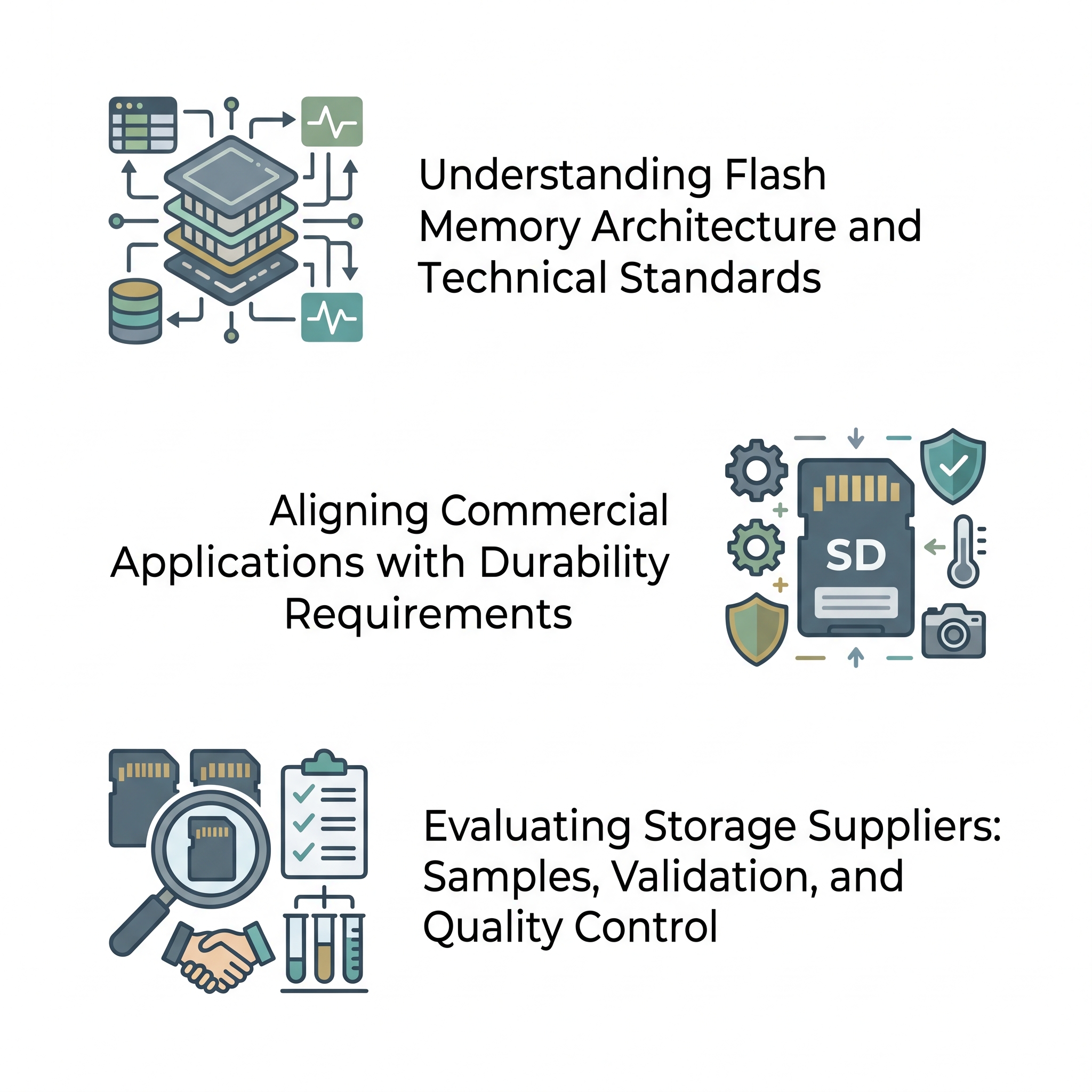
Understanding Flash Memory Architecture and Technical Standards

The internal architecture of a memory card dictates write endurance, data retention, and performance consistency. When reviewing component specifications for bulk SD cards, hardware procurement teams must look past the external card label and evaluate the underlying flash silicon and controller pairing.
NAND Flash Grades and Cell Topologies
NAND flash storage comes in several core cell architectures, each offering different trade-offs between physical cell endurance and data density:
- SLC (Single-Level Cell): Stores one bit per cell. Offers the highest endurance, fastest transfer speeds, and maximum operating temperature resilience. SLC is primarily specified for mission-critical industrial controllers and telematics systems.
- pSLC (Pseudo Single-Level Cell): Configures multi-bit flash cells to operate in single-bit mode through firmware algorithms. This delivers near-SLC reliability and high write cycles at a lower manufacturing cost than native SLC silicon.
- MLC (Multi-Level Cell): Stores two bits per cell. Long the standard for enterprise logging and heavy continuous video capture.
- TLC (Triple-Level Cell): Stores three bits per cell. Standard for commercial products and consumer-facing devices. Industrial 3D TLC variants now incorporate specialized controller firmware to deliver stable continuous recording.
Procurement managers should explicitly request information on the controller manufacturer and the NAND die tier used in the assembly. Industrial-grade solutions often feature locked bills of materials (Fixed BOM), ensuring that the controller model, firmware revision, and flash silicon do not change across successive production batches without formal engineering change notifications (PCN).
Speed Class Classifications and Bus Standards
Speed classifications establish minimum sustained sequential write rates, which are critical for streaming media and embedded real-time systems. The SD Association defines several speed standards that procurement teams must verify against device host requirements:
- Standard Speed Class (Class 10): Minimum sequential write speed of ten megabytes per second.
- UHS Speed Class (U1 and U3): U1 supports ten megabytes per second, while U3 supports thirty megabytes per second, operating over the Ultra High Speed bus interface.
- Video Speed Class (V30, V60, V90): Designed for high-bitrate video, guaranteeing sustained write performance of thirty, sixty, or ninety megabytes per second.
- Application Performance Class (A1 and A2): Measures random read and write Input/Output Operations Per Second (IOPS) alongside sustained sequential writing. Devices running an operating system or localized databases directly from the card require A1 or A2 compliance to avoid OS thread lockups.
Evaluating the full spectrum of memory cards against your host processor’s SD interface specification prevents costly interface bottlenecks.
Technical Standards Comparison
To simplify component qualification and evaluate performance trade-offs during volume procurement, hardware and procurement teams can benchmark standard specifications across cell topologies and speed classifications:
| Architecture / Standard | Primary Cell Characteristics | Minimum Sustained Speed | Ideal Application Profile |
|---|---|---|---|
| SLC | 1 bit per cell; maximum endurance & stability | Varies by interface bus | Critical industrial automation, PLCs, aerospace telematics |
| pSLC | Emulated single-bit mode via multi-bit flash | Host interface dependent | Continuous logging, enterprise edge gateways, mission telemetry |
| MLC | 2 bits per cell; high write durability | Host interface dependent | Heavy commercial video capture, surveillance infrastructure |
| TLC / 3D TLC | 3 bits per cell; high storage density | Interface / Controller dependent | Consumer hardware bundles, client devices, standard retail |
| Class 10 / U1 | Standard bus write timing | 10 MB/s sequential write | General purpose storage, basic data logging, peripheral firmware |
| UHS U3 / V30 | Ultra High Speed continuous video bus | 30 MB/s sequential write | 4K video recording, multi-channel dash cameras, surveillance |
| Video Speed Class V60 / V90 | High-throughput multi-lane flash interface | 60 MB/s to 90 MB/s sustained write | High-bitrate video streaming, burst raw imaging, advanced edge sensors |
| Application Class A1 / A2 | Random IOPS-focused controller firmware | 10 MB/s + Random IOPS compliance | Embedded operating systems, edge database logging, Android devices |
Aligning Commercial Applications with Durability Requirements
Every embedded system interacts with storage media under distinct environmental and operational stresses. Deploying an off-the-shelf consumer flash card into continuous industrial recording environments invariably leads to early wear-out.
Industrial Automation and IoT Edge Nodes
Edge telemetry devices, programmable logic controllers (PLCs), and remote gateways often run continuous background logging. In these settings, power interruptions are frequent, meaning the memory card controller must feature robust power-loss protection (PLP) firmware algorithms to prevent file allocation table corruption during an unexpected blackout. Industrial cards also feature wider operating temperature profiles to maintain integrity in unconditioned factory cabinets or outdoor junction boxes.
Video Surveillance and Fleet Telematics
Dash cameras, body-worn cameras, and security video systems generate constant sequential writes. Standard consumer cards distribute writes across standard blocks, quickly exceeding the program-erase cycle ceiling. Sourcing high-endurance or surveillance-optimized media ensures that the firmware handles cyclical overwriting smoothly, without dropouts or recording stutter.
Preloaded Firmware and Consumer Hardware Bundles
When sourcing removable media for consumer electronics bundles or bundled marketing collateral, buyers often balance unit economics with brand integrity. While raw endurance requirements may be lower than those of edge telematics, controller read stability remains paramount. Buyers managing varied storage integration projects often coordinate their media procurement alongside an oem usb flash drive factory to unify testing methodologies across peripheral product lines.
Evaluating Storage Suppliers: Samples, Validation, and Quality Control

To safeguard an OEM or ODM manufacturing schedule, procurement teams must enforce systematic supplier vetting before signing volume purchase agreements. Relying exclusively on static product spec sheets exposes the supply chain to variability in raw flash quality.
Pilot Run Sampling and Lab Testing
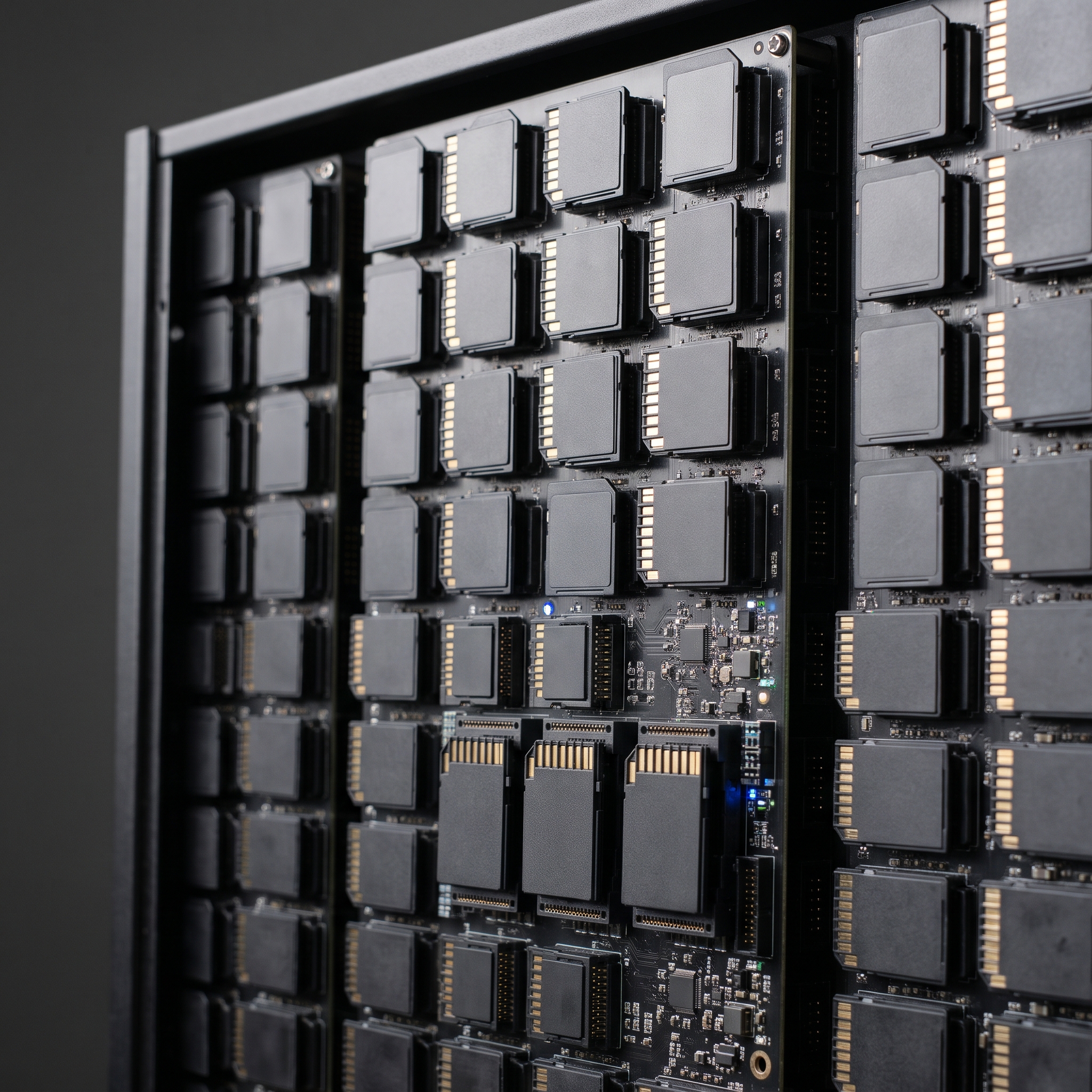
Before issuing a high-volume purchase order for bulk SD cards, teams should secure an engineering sample run for bench validation. The internal validation process should examine several operational metrics:
- Full-Capacity Verification: Utilizing software diagnostics to ensure the controller reports legitimate usable capacity without cyclic cell spoofing.
- Sustained Write Burn-In: Performing continuous, multi-pass write-verify tests across the entire logical block range to identify bad blocks, latency spikes, or early controller throttling.
- Thermal Stress Cycling: Operating the media inside host devices placed within thermal chambers to confirm functional data retention across the application’s required temperature envelope.
- Power-Cycle Stress: Simulating hundreds of sudden power interrupts during active write cycles to confirm that the controller’s internal metadata recovery handles unexpected drops cleanly.
Engaging a supplier that offers dedicated OEM and ODM manufacturing services provides direct engineering transparency into the controller architecture and firmware configuration.
Managing the Procurement Workflow and Supply Chain Risks
Procurement execution requires disciplined supply chain governance to secure consistent components, fair commercial terms, and on-schedule fulfillment.
Guarding Against Counterfeits and Grey Market Stock
The flash memory distribution landscape contains counterfeit products, remarked downgrade dies, and repackaged grey-market stock. Downgraded flash chips (cells that failed semiconductor fabrication binning) are sometimes packaged into generic cards, leading to premature corruption and elevated field failures.
To mitigate these risks, procurement managers should:
- Source directly through established manufacturing partners or authorized channel distributors with full lot traceability.
- Demand Certificate of Conformance (CoC) documentation for every shipment.
- Implement incoming lot quality control (IQC) using automated flash testers that pull random samples from arriving pallets for capacity and transfer speed validation.
Managing Lead Times and Material Shortages
Upstream silicon wafer supply cycles fluctuate based on global memory market capacity. Sudden shortages in raw NAND flash or controller fabrication capacity can trigger lead time spikes. Sourcing teams mitigate supply volatility by establishing safety buffer stocks, locking down production forecast windows with factory partners, and standardizing storage form factors across internal product lines. For complex computing appliances requiring complementary fixed storage, evaluating compatible wholesale solid state drive manufacturer options early simplifies overarching supply vendor management.
Frequently Asked Questions
What is the functional difference between industrial-grade and consumer-grade SD cards?
Industrial-grade cards generally use SLC or pSLC memory cell configurations, locked bills of materials (Fixed BOM), wider operating temperature ranges, and firmware optimized for continuous logging and power-loss protection. Consumer cards prioritize high storage density and low cost per gigabyte, utilizing TLC or QLC flash that is intended for occasional burst reads and writes.
How can buyers verify that bulk memory cards contain genuine flash memory?
Buyers should run incoming acceptance testing using full-capacity read-write diagnostic utilities on a statistically representative sample from each lot. Verifying batch lot codes, validating sustained sequential write speeds, and requiring clear component provenance from the supplier prevents the integration of counterfeit or downgraded flash stock.
Why does Fixed BOM matter in volume procurement?
A Fixed Bill of Materials guarantees that the supplier will not alter the internal flash controller, firmware code, or NAND flash silicon revision without issuing a formal engineering change notice. This prevents sudden firmware-level incompatibilities in embedded devices that have already passed field compliance testing.
Can commercial high-endurance cards substitute for specialized industrial flash?
For applications with moderate write cycles operating in controlled indoor environments, such as commercial digital signage or office surveillance, high-endurance cards can serve as a dependable, budget-conscious solution. However, extreme operating environments, unbuffered power systems, and mission-critical devices require dedicated industrial-grade storage to ensure long-term data retention.
Building a Stable Sourcing Strategy
Selecting flash storage for production deployments requires balancing component-level reliability with commercial predictability. By aligning host firmware requirements with the proper flash cell architecture, enforcing incoming quality inspections, and collaborating with transparent supply chain partners, hardware teams secure stable component yields and mitigate long-term maintenance costs. Hardware developers and procurement teams seeking technical consultation on storage validation can connect through Dellwa contact channels to discuss project-specific memory requirements.