

Industrial Micro SD Card Supplier Guide: Industrial Specs, Samples, and Sourcing Risks
Buyers searching for industrial micro sd card are usually past the research-only stage. They are trying to decide which supplier can support real purchasing work: samples, stable specifications, packaging, documentation, lead time, and repeat orders. For Dellwa, this topic is a strong SEO opportunity because it connects search demand to actual B2B flash storage and component sourcing conversations.
This guide is written for industrial device makers, camera brands, IoT builders, and distributors. It explains how to evaluate industrial memory card options, what risks to check before an RFQ, and how Dellwa can position the conversation around product fit instead of only price.
Quick Answer for Industrial Micro SD Card
The best industrial micro sd card supplier is not simply the cheapest vendor. A qualified supplier should explain the product grade, confirm component consistency, support samples, document packaging requirements, and communicate substitution risk before production starts.
For Dellwa, the practical buyer path is:
- Confirm the target application and expected operating environment.
- Match the product category to the use case: microSD cards, SD cards, industrial memory cards, OEM packaged cards.
- Validate samples before committing to a repeat-order schedule.
- Lock packaging, label, and logistics requirements early.
- Keep a clear record of capacity, interface, controller, and component expectations.
Search Intent and SEO Opportunity
The prepared Ahrefs seed lists industrial micro sd card with estimated monthly volume of 900, keyword difficulty 28, CPC $3.40, and it is currently around position 18 in the prepared Ahrefs export. That makes the topic useful for both classic SEO and AI search visibility: it has enough buyer intent to justify a detailed guide, but it also needs clear entity coverage so answer engines understand what Dellwa supplies.
Searchers at this stage usually want one of three things. Some want a manufacturer or supplier shortlist. Some want a checklist for comparing product quality. Others want to understand whether an industrial or OEM-grade option is different from a consumer product. A strong page should satisfy all three intents without becoming a generic glossary.
Product Fit: What Buyers Should Specify
Start with the application, not the quote sheet. An industrial memory card used in dash cameras, industrial PCs, security cameras, IoT gateways may need different validation than the same category sold for simple retail use. The buyer should define capacity, interface, casing or card type, package format, temperature exposure, expected write workload, and the order rhythm.
For Dellwa, this is where the sales conversation can become specific. Instead of asking only for a target price, buyers can share the product environment, annual demand, label or logo requirements, and any import or retail documentation they need. That gives Dellwa a cleaner path to recommend a matched storage or component option.
Industrial MicroSD vs Consumer MicroSD Cards
An industrial microSD card is designed for applications where operating conditions, write workload, product lifecycle, and component consistency matter more than retail price alone. Consumer cards may work well for personal storage, but they are not automatically suitable for security cameras, industrial PCs, IoT gateways, transportation systems, or devices that write data continuously.
The term “industrial” should be supported by measurable specifications. Buyers should confirm which features make the proposed card suitable for the actual device rather than relying only on the product name.
Key Differences Buyers Should Compare
| Evaluation area | Consumer microSD | Industrial microSD |
|---|---|---|
| Primary use | Personal storage and general electronics | Embedded, commercial, and industrial equipment |
| Write workload | Occasional file storage | Continuous or frequent data writing |
| Operating environment | Normal consumer environments | Wider or application-specific temperature range |
| Component control | Components may change during the retail lifecycle | Greater emphasis on NAND, controller, and firmware consistency |
| Product lifecycle | Models may change frequently | Longer supply planning may be available |
| Monitoring functions | Usually limited | Health monitoring may be available on selected models |
| Qualification | Basic device compatibility | Device, workload, and environmental validation |
Actual specifications vary by model. Not every industrial microSD card offers the same temperature range, endurance, firmware features, or lifecycle support.
When an Industrial Card Is More Appropriate
Industrial-grade options should be considered when the application involves continuous recording, frequent overwriting, difficult maintenance access, outdoor installation, temperature fluctuation, vibration, or high replacement costs.
Consider the Cost of Failure
The purchasing decision should reflect what happens after a card fails. If replacement requires a technician visit, equipment shutdown, lost video, or product recall, endurance and specification consistency may be more valuable than a lower initial unit price.
Endurance, Speed Classes, and Write Workload
Capacity and interface do not fully describe whether a microSD card is suitable for an industrial device. Buyers should also define how frequently the system writes data, the typical file size, the recording bitrate, and the expected service life.
Understanding Write Endurance
Write endurance describes how much data a card is expected to write during its useful operating life. Depending on the product, it may be expressed as total bytes written, program/erase cycles, recorded hours, or another model-specific measurement.
Information Needed for Endurance Planning
A practical endurance estimate should consider daily operating hours, average recording bitrate, percentage of time spent writing, overwrite behavior, and required service life.
For example, a surveillance camera recording continuously creates a different workload from an IoT gateway writing a small log file every few minutes. Buyers should provide the real workload instead of selecting a card based only on capacity.
Understanding Speed-Class Labels
Labels such as Class 10, U1, U3, V30, and Application Performance Class describe specific minimum performance requirements. They do not guarantee identical behavior in every host device.
| Performance term | What it helps describe |
|---|---|
| UHS Speed Class | Minimum sequential write performance |
| Video Speed Class | Sustained writing for video workloads |
| Application Performance Class | Random read and write performance |
| Sustained write speed | Stability during continuous data recording |
| Random performance | Access to operating-system and small application files |
Why Real-Device Testing Still Matters
Actual performance can be affected by the host controller, firmware, file system, file size, temperature, and power conditions. A card that performs well in a desktop card reader may behave differently inside a camera, gateway, or embedded computer.
The supplier should identify the ratings and tested performance of the proposed model. The buyer should then verify that the card maintains the required write speed inside the target device.
Supplier Evaluation Checklist
Use this checklist before selecting an industrial micro sd card supplier:
- NAND grade and controller consistency
- temperature range and endurance requirements
- capacity road map for repeat orders
- labeling, barcode, and packaging support
- sample testing before mass production
The same checklist also helps procurement teams compare quotes fairly. A lower unit price may not be a better offer if the supplier cannot explain component stability, sample approval, packaging control, or lead-time risk.
Common Procurement Risks
Three issues create most problems in B2B storage and component sourcing:
- consumer-grade cards being sold into industrial projects
- unannounced controller or NAND substitutions
- unclear warranty terms for write-heavy applications
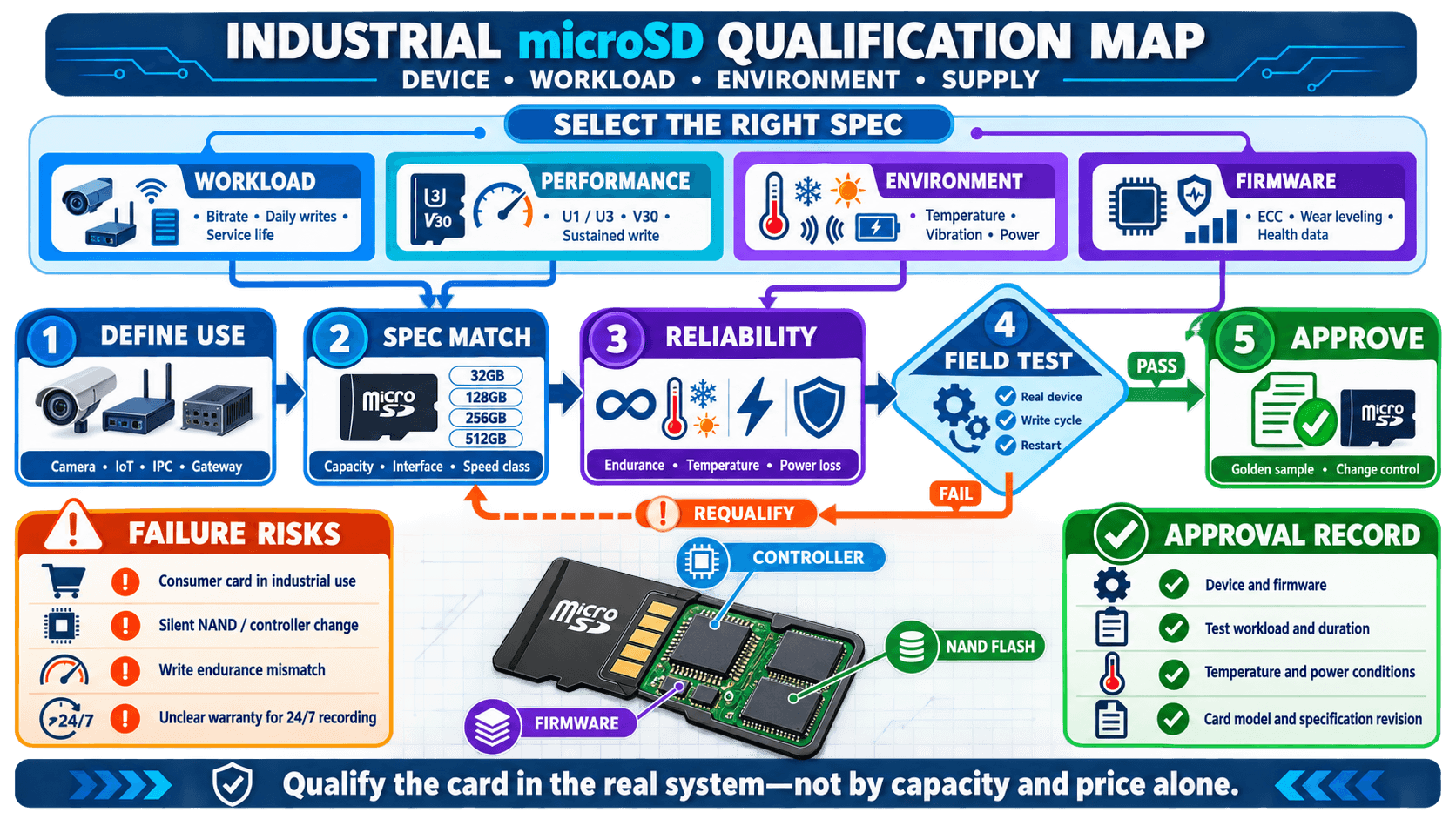
How to Validate Industrial MicroSD Card Samples
An industrial microSD sample should be tested in the actual device under a workload that resembles real operation. A desktop capacity or speed test alone cannot confirm long-term stability in a camera, gateway, embedded computer, or transportation system.
Device Compatibility Test
The device should consistently detect, format, read, and write to the card. Testing should include normal startup, restart, card reinsertion, automatic formatting, and operation as the card approaches full capacity.
Workload and Recording Test
The test should reproduce the expected bitrate, file size, overwrite cycle, and daily operating schedule. Continuous-recording projects should test loop recording and repeated file replacement instead of copying one large test file only once.
Environmental Test
Where relevant, the card should be evaluated under the expected temperature, vibration, humidity, and power conditions. Testing the complete device enclosure is important because the card’s actual operating temperature may differ from the surrounding environment.
Power-Interruption Test
If unexpected shutdowns are possible, the buyer should test repeated power loss while the device is writing data. After each interruption, the system should verify file accessibility, file-system integrity, recording continuity, and successful restart.
Sample Approval Record
| Test category | Information to retain |
|---|---|
| Product | Brand, model, capacity, and interface |
| Device | Host model, firmware, and file system |
| Performance | Test method, file size, and measured results |
| Workload | Bitrate, write pattern, and test duration |
| Environment | Temperature, vibration, and power conditions |
| Components | NAND, controller, or approved configuration where available |
| Approval | Test date, specification revision, and responsible person |
Golden Sample
The approved sample and its test record should become the golden sample reference for production. If a critical component or firmware changes, the buyer can use this record to determine whether requalification is necessary.
These risks are especially important for repeat-order buyers. If the first shipment passes but later shipments change silently, the buyer may face warranty claims, inconsistent product performance, or delays caused by requalification.
RFQ Questions to Ask Dellwa
Before sending a purchase order, buyers can use these questions to make the RFQ more useful:
- Which product grade do you recommend for this application, and why?
- What capacity, interface, casing, or package formats are available for repeat orders?
- Can samples be matched to the expected mass-production specification?
- What packaging, labeling, barcode, or logo options can be prepared?
- What documentation can be provided for import, resale, or internal approval?
- How are component substitutions communicated before production?
- What lead time should we expect for sample approval, production, and repeat orders?
These questions make the buyer look serious and help Dellwa qualify the project faster.
How Dellwa Can Position the Offer
Dellwa should position this article around practical B2B readiness: flash storage products, memory card supply, SSD options, custom USB support, and electronic component sourcing. The page should make clear that Dellwa can discuss OEM and distribution needs, not only single-product transactions.
The strongest message is operational: buyers can bring an application, a target volume, and packaging requirements, then Dellwa can help narrow the product path. That is more credible than overpromising every specification on one page.
Buyer Vocabulary to Confirm
When buyers discuss this category with Dellwa, they should be ready to confirm terms such as microSD, SD card, NAND flash, controller, endurance, temperature range, OEM packaging. These terms are not just catalog labels. They affect sample approval, RFQ comparison, packaging instructions, lead time, warranty exposure, and repeat-order consistency.
The clearer the vocabulary, the easier it is for Dellwa to recommend the right product path. A buyer asking about industrial microsd cards may also need OEM flash storage support, B2B memory sourcing, or industrial storage procurement guidance, so the RFQ should describe the application instead of relying on a short part name alone.
FAQ
What should I check before choosing an industrial micro sd card supplier?
Check product grade, component consistency, sample approval, packaging requirements, lead time, and documentation. For industrial or OEM projects, also ask how substitutions are handled before repeat orders.
Is price the most important factor for industrial micro sd card?
Price matters, but it should be compared only after product requirements are clear. A cheap quote can become expensive if the supplier changes components, misses packaging requirements, or cannot support repeat-order consistency.
Can Dellwa support OEM or private-label requirements?
Dellwa is a better fit when buyers need B2B sourcing support for storage, memory, USB, SSD, or component categories. For OEM or private-label work, buyers should share logo, label, package, file preload, capacity, and shipment requirements at the RFQ stage.
Why does sample approval matter?
Sample approval reduces the risk that the mass-production shipment differs from what the buyer tested. It also gives both sides a clear reference for capacity, casing, performance expectations, and packaging details.
How should a buyer start a conversation with Dellwa?
Start with the application, target quantity, required capacity or component type, destination market, packaging needs, and expected timeline. That gives Dellwa enough context to recommend a practical product path.
Buyer Takeaway
Use industrial micro sd card as a high-intent sourcing signal, but qualify the supplier with application details, quality expectations, and repeat-order controls. Dellwa can use this topic to show buyers that it understands B2B procurement, not just product listing pages.