
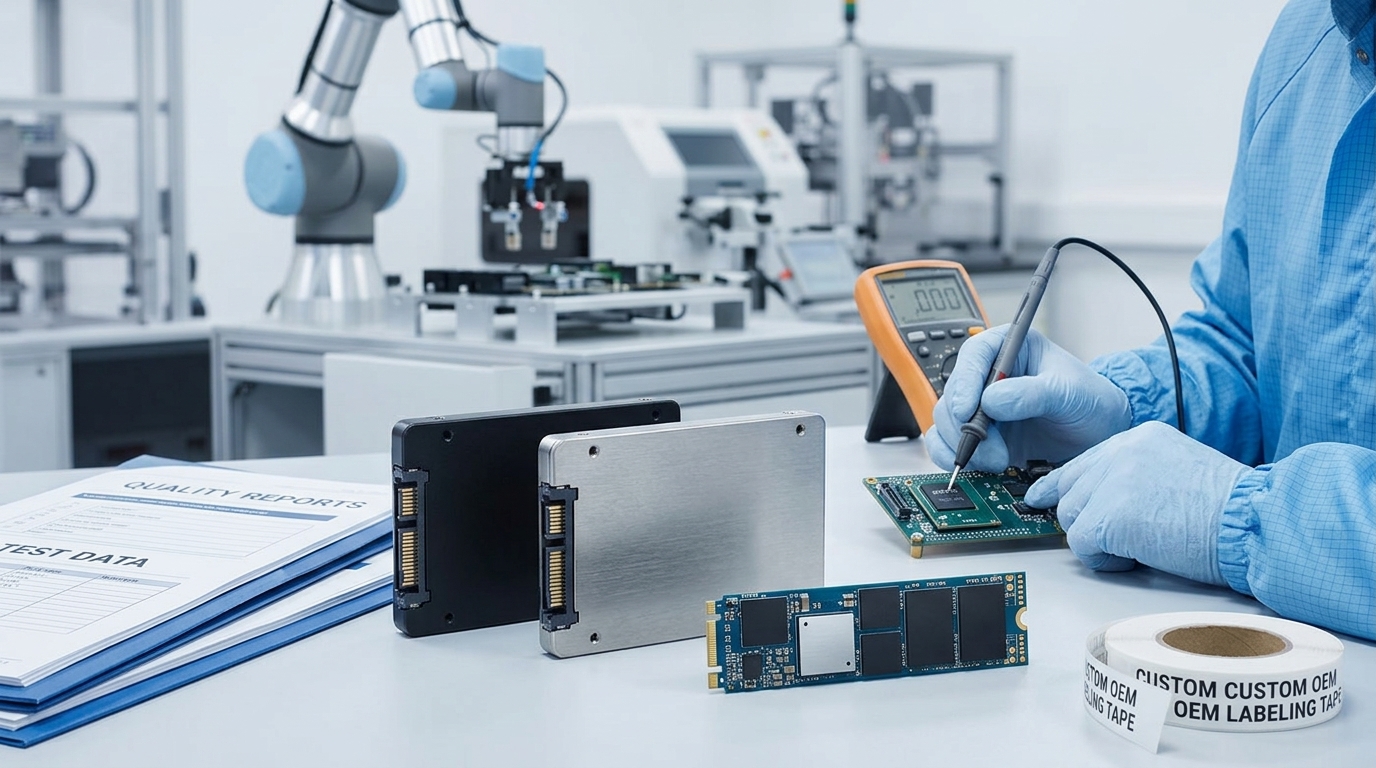
SSD OEM Manufacturer Sourcing Guide: Specs, Reliability, and RFQ Checklist
Buyers searching for ssd oem manufacturer are usually past the research-only stage. They are trying to decide which supplier can support real purchasing work: samples, stable specifications, packaging, documentation, lead time, and repeat orders. For Dellwa, this topic is a strong SEO opportunity because it connects search demand to actual B2B flash storage and component sourcing conversations.
This guide is written for industrial PC makers, embedded system teams, and OEM hardware buyers. It explains how to evaluate industrial SSD options, what risks to check before an RFQ, and how Dellwa can position the conversation around product fit instead of only price.
Quick Answer for SSD OEM Manufacturer
The best ssd oem manufacturer supplier is not simply the cheapest vendor. A qualified supplier should explain the product grade, confirm component consistency, support samples, document packaging requirements, and communicate substitution risk before production starts.
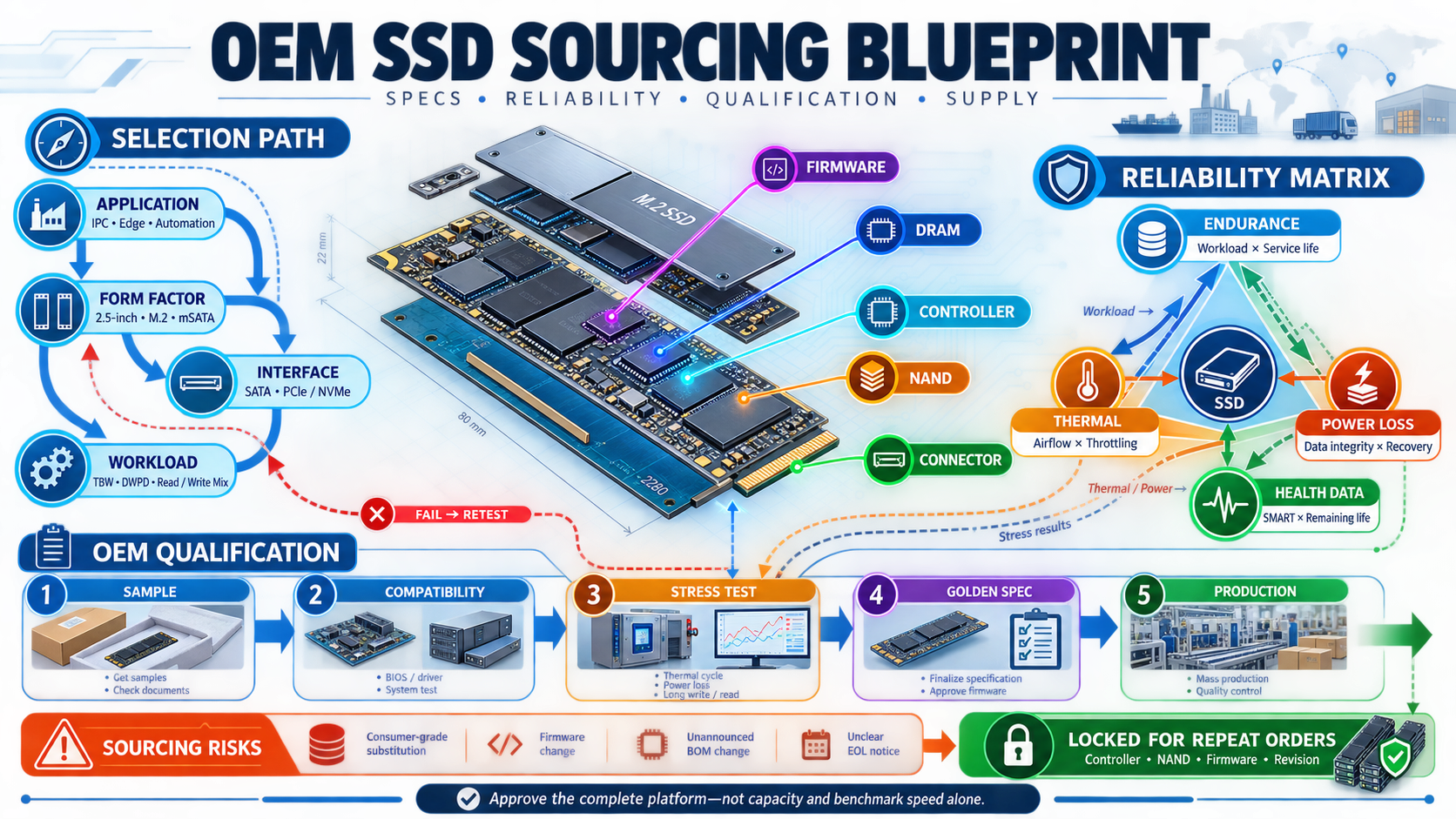
For Dellwa, the practical buyer path is:
- Confirm the target application and expected operating environment.
- Match the product category to the use case: SATA SSDs, M.2 SSDs, mSATA SSDs, industrial SSD modules.
- Validate samples before committing to a repeat-order schedule.
- Lock packaging, label, and logistics requirements early.
- Keep a clear record of capacity, interface, controller, and component expectations.
Search Intent and SEO Opportunity
The prepared Ahrefs seed lists ssd oem manufacturer with estimated monthly volume of 800, keyword difficulty 36, CPC $5.20, and it is currently around position 26 in the prepared Ahrefs export. That makes the topic useful for both classic SEO and AI search visibility: it has enough buyer intent to justify a detailed guide, but it also needs clear entity coverage so answer engines understand what Dellwa supplies.
Searchers at this stage usually want one of three things. Some want a manufacturer or supplier shortlist. Some want a checklist for comparing product quality. Others want to understand whether an industrial or OEM-grade option is different from a consumer product. A strong page should satisfy all three intents without becoming a generic glossary.
Product Fit: What Buyers Should Specify
Start with the application, not the quote sheet. An industrial SSD used in industrial PCs, edge devices, embedded computers, automation equipment may need different validation than the same category sold for simple retail use. The buyer should define capacity, interface, casing or card type, package format, temperature exposure, expected write workload, and the order rhythm.
For Dellwa, this is where the sales conversation can become specific. Instead of asking only for a target price, buyers can share the product environment, annual demand, label or logo requirements, and any import or retail documentation they need. That gives Dellwa a cleaner path to recommend a matched storage or component option.
SSD Form Factor and Interface Compatibility
An SSD must match both the physical slot and the electrical interface of the target system. A drive that fits mechanically may still be incompatible with the motherboard, BIOS, connector key, or operating system.
Common OEM SSD Form Factors
| Form factor | Typical application | Buyer consideration |
|---|---|---|
| 2.5-inch SSD | Industrial PCs, servers and equipment upgrades | Confirm SATA interface, thickness and mounting space |
| M.2 2280 | Embedded systems, edge devices and compact PCs | Confirm length, key type, interface and thermal clearance |
| M.2 2242 | Space-constrained embedded equipment | Capacity and model availability may be more limited |
| mSATA | Legacy industrial and embedded platforms | Verify slot support and long-term availability |
| Industrial module | Specialized equipment and fixed designs | May require extended qualification and lifecycle planning |
SATA vs PCIe/NVMe
SATA SSDs are widely supported and may be suitable for stable industrial platforms that do not require extremely high throughput. NVMe SSDs use PCIe lanes and can provide higher performance, but they may also produce more heat and require additional BIOS, driver, and thermal validation.
M.2 Does Not Automatically Mean NVMe
M.2 describes the physical form factor, not the communication protocol. An M.2 SSD may use SATA or PCIe/NVMe, and the system slot may support one interface, both interfaces, or only specific key types.
Before requesting a quotation, buyers should confirm:
- Form factor and module length
- SATA or PCIe/NVMe interface
- M.2 key type
- PCIe generation and lane support
- BIOS and operating-system compatibility
- Available airflow and thermal clearance
A clear host-system specification helps the supplier avoid recommending a drive that fits physically but cannot operate correctly.
NAND Type, TBW, DWPD, and Workload Fit
SSD endurance should be selected according to the expected write workload and required service life. Capacity and benchmark speed alone do not indicate whether an SSD is suitable for an industrial application.
NAND Flash Selection
Different NAND technologies provide different balances of endurance, capacity, performance, and cost.
| NAND type | General characteristic | Typical sourcing consideration |
|---|---|---|
| SLC | High endurance and lower density | Specialized applications with intensive writing |
| pSLC | Uses part of MLC or TLC capacity in SLC mode | Balance of endurance, performance and cost |
| MLC | Higher endurance than many mainstream TLC products | Availability and lifecycle should be confirmed |
| TLC | Common balance of cost, capacity and performance | Endurance must be matched to the workload |
| QLC | Higher density and lower cost per GB | More suitable for read-focused or lighter-write workloads |
The actual reliability of an SSD also depends on the controller, firmware, over-provisioning, error correction, thermal conditions, and workload pattern. NAND type should therefore be evaluated as part of the complete platform.
Understanding TBW
TBW, or terabytes written, estimates the total amount of data that can be written during the product’s specified endurance period. A higher-capacity model may have a higher TBW rating because it contains more NAND available for wear distribution.
Understanding DWPD
DWPD, or drive writes per day, estimates how many times the full drive capacity can be written each day during a specified warranty period.
Example of Workload Planning
A 1TB SSD rated for 0.3 DWPD over five years is intended to support approximately 300GB of host writes per day during that period. This is a planning estimate, and buyers should confirm how the manufacturer defines the rating.
Define the Real Workload
Buyers should estimate the average and peak daily writes, read/write ratio, file size, logging frequency, database activity, operating hours, and expected service life.
An edge server processing video or AI data may require a different SSD from an industrial PC that mainly boots software and stores occasional production records.
Supplier Evaluation Checklist
Use this checklist before selecting a ssd oem manufacturer supplier:
- form factor and interface compatibility
- controller and firmware stability
- BOM continuity across repeat orders
- write endurance and workload fit
- thermal behavior in enclosed systems
The same checklist also helps procurement teams compare quotes fairly. A lower unit price may not be a better offer if the supplier cannot explain component stability, sample approval, packaging control, or lead-time risk.
Common Procurement Risks
Three issues create most problems in B2B storage and component sourcing:
- consumer SSD substitutions in long-life industrial builds
- firmware changes without buyer approval
- unclear lifecycle notice for controller or NAND changes
These risks are especially important for repeat-order buyers. If the first shipment passes but later shipments change silently, the buyer may face warranty claims, inconsistent product performance, or delays caused by requalification.
RFQ Questions to Ask Dellwa
Before sending a purchase order, buyers can use these questions to make the RFQ more useful:
- Which product grade do you recommend for this application, and why?
- What capacity, interface, casing, or package formats are available for repeat orders?
- Can samples be matched to the expected mass-production specification?
- What packaging, labeling, barcode, or logo options can be prepared?
- What documentation can be provided for import, resale, or internal approval?
- How are component substitutions communicated before production?
- What lead time should we expect for sample approval, production, and repeat orders?
These questions make the buyer look serious and help Dellwa qualify the project faster.
How Dellwa Can Position the Offer
Dellwa should position this article around practical B2B readiness: flash storage products, memory card supply, SSD options, custom USB support, and electronic component sourcing. The page should make clear that Dellwa can discuss OEM and distribution needs, not only single-product transactions.
The strongest message is operational: buyers can bring an application, a target volume, and packaging requirements, then Dellwa can help narrow the product path. That is more credible than overpromising every specification on one page.
Buyer Vocabulary to Confirm
When buyers discuss this category with Dellwa, they should be ready to confirm terms such as SATA, M.2, mSATA, NAND flash, firmware, TBW, BOM continuity. These terms are not just catalog labels. They affect sample approval, RFQ comparison, packaging instructions, lead time, warranty exposure, and repeat-order consistency.
The clearer the vocabulary, the easier it is for Dellwa to recommend the right product path. A buyer asking about oem ssd manufacturing may also need OEM flash storage support, B2B memory sourcing, or industrial storage procurement guidance, so the RFQ should describe the application instead of relying on a short part name alone.
BOM, Firmware, and Product Lifecycle Control
OEM buyers may spend significant time qualifying an SSD for a hardware platform. An unannounced change to the controller, NAND, DRAM, firmware, or PCB can create compatibility and performance risks even when the model name and capacity remain unchanged.
Bill of Materials Control
The buyer and supplier should agree on which components are fixed and which equivalent substitutions may be permitted.
Components That May Require Control
The approved specification may identify:
- SSD controller
- NAND type and generation
- DRAM configuration
- Firmware revision
- PCB design
- Form factor and connector
- Thermal design
- Product label and revision
If the exact component cannot be fixed, the supplier should define the performance, endurance, compatibility, and reliability requirements that any substitute must meet.
Firmware Revision Control
Firmware affects NAND management, power behavior, error correction, performance, security functions, and host compatibility. A new firmware version should not automatically enter production merely because the physical hardware is unchanged.
The buyer should determine whether a firmware update requires notification, release notes, a new sample, partial testing, or complete platform requalification.
Product Change Notification
A product change notification process should cover changes that may affect:
- Form, fit, or function
- Performance or endurance
- Power consumption
- Thermal behavior
- Firmware features
- Host compatibility
- Manufacturing location
- Label or packaging
- Regulatory documentation
End-of-Life Planning
Industrial and embedded systems may remain in production for several years. Buyers should ask about the planned product lifecycle, last-time-buy notice, replacement recommendations, and sample availability for the successor model.
Qualify the Replacement Early
Where possible, the OEM team should begin evaluating a replacement SSD before the existing model reaches end of life. Early qualification reduces the risk of urgent sourcing, production interruption, or accepting an unsuitable consumer-grade substitute.
Repeat-Order Specification
Every repeat order should reference the approved model, BOM or revision, firmware, golden sample, packaging, label, and previous purchase order. Capacity and interface alone are not sufficient to maintain an identical OEM configuration.
FAQ
What should I check before choosing a ssd oem manufacturer supplier?
Check product grade, component consistency, sample approval, packaging requirements, lead time, and documentation. For industrial or OEM projects, also ask how substitutions are handled before repeat orders.
Is price the most important factor for ssd oem manufacturer?
Price matters, but it should be compared only after product requirements are clear. A cheap quote can become expensive if the supplier changes components, misses packaging requirements, or cannot support repeat-order consistency.
Can Dellwa support OEM or private-label requirements?
Dellwa is a better fit when buyers need B2B sourcing support for storage, memory, USB, SSD, or component categories. For OEM or private-label work, buyers should share logo, label, package, file preload, capacity, and shipment requirements at the RFQ stage.
Why does sample approval matter?
Sample approval reduces the risk that the mass-production shipment differs from what the buyer tested. It also gives both sides a clear reference for capacity, casing, performance expectations, and packaging details.
How should a buyer start a conversation with Dellwa?
Start with the application, target quantity, required capacity or component type, destination market, packaging needs, and expected timeline. That gives Dellwa enough context to recommend a practical product path.
Buyer Takeaway
Use ssd oem manufacturer as a high-intent sourcing signal, but qualify the supplier with application details, quality expectations, and repeat-order controls. Dellwa can use this topic to show buyers that it understands B2B procurement, not just product listing pages.